How to Ride Safely in Traffic
Learn how to cycle safely in UK traffic with step-by-step guidance on road positioning, junctions, dooring, group riding, and your legal obligations.
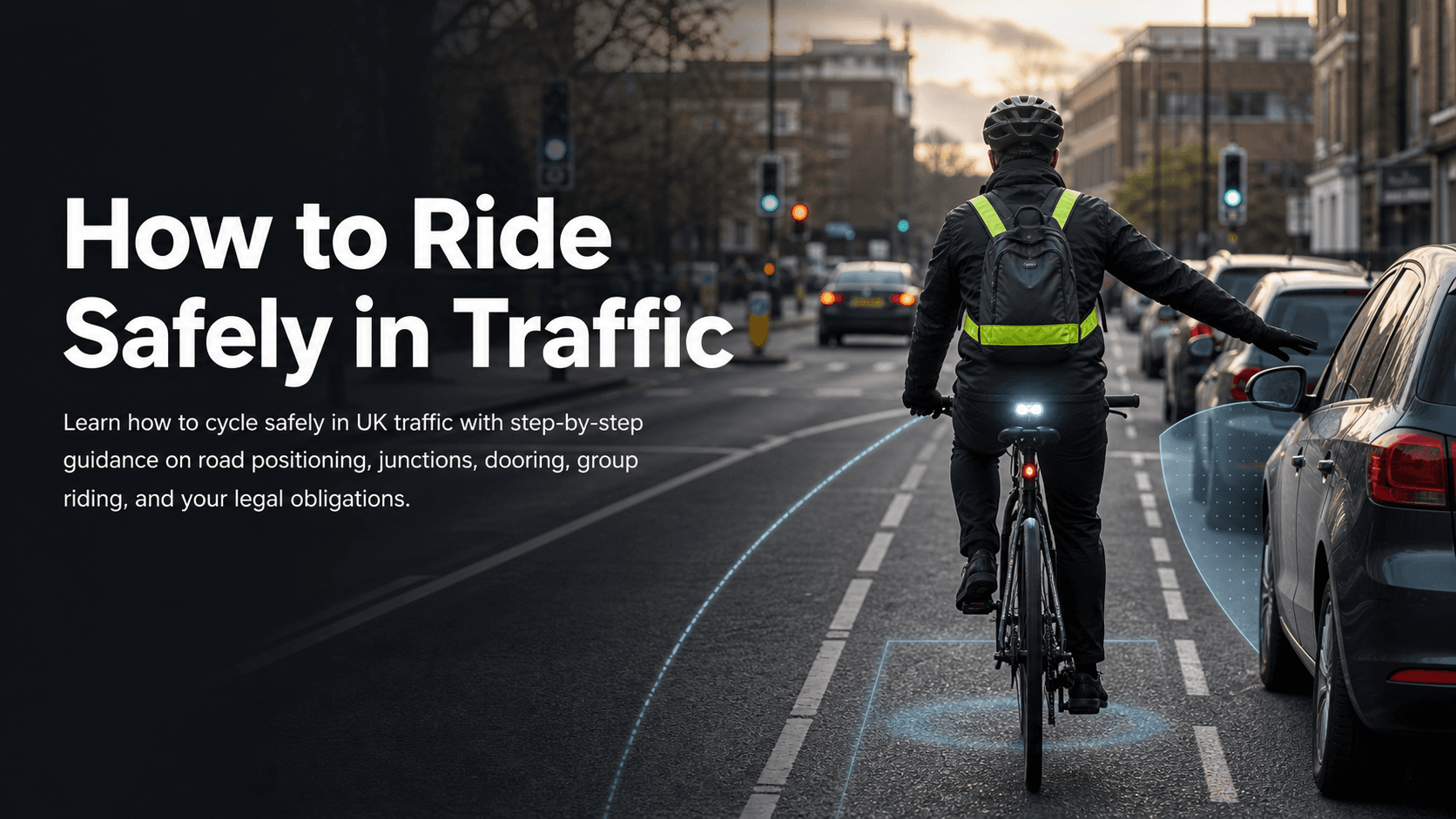
You don't need to be fearless to ride safely in traffic. You need to be predictable. That one shift in mindset changes everything about how you approach a busy road, a tight junction, or a line of parked cars.
According to the Department for Transport's 2024 pedal cycle factsheet, 82 cyclists were killed in Great Britain and 3,822 were seriously injured (adjusted figures). Those numbers aren't meant to scare you off the road. They're a reminder that informed, skilled riding makes a real difference.
This guide is for UK road cyclists who want practical, step-by-step answers: where to position yourself, how to handle junctions, what the law actually requires, and how to ride confidently in a group. Everything here is grounded in the Highway Code (Rules 59–82 on GOV.UK), Cycling UK guidance, and the THINK! road safety programme.
What 'safe' actually means on a bike
Cycling UK frames safe riding around four core behaviours: observation, communication, priority awareness, and correct road positioning. Get those four right and you're already ahead of most hazards before they materialise.
Observation means looking well ahead and scanning continuously, not just at the car in front. Communication means signalling clearly and making eye contact with drivers at junctions. Priority awareness means understanding who has right of way and not assuming. Positioning means being where other road users can see you and where you have the most control.
The rest of this guide is essentially those four things, broken down by situation.
The Highway Code basics: what you must get right
The Highway Code uses two distinct words: must (a legal requirement) and should (strong advice). Cycling UK's legal guide makes this distinction clearly, and it's worth understanding the difference.
Here are the non-negotiables:
- You must not cycle on the pavement (Highway Code Rule 64). It's an offence under the Highway Act 1835 and can result in a Fixed Penalty Notice.
- You must use lights between sunset and sunrise. Under the Road Vehicles Lighting Regulations 1989, you need a white front light and a red rear light, plus a red rear reflector. Pedal reflectors are also required on bikes manufactured after 1985. (More on this in the lights section below.)
- You must obey traffic lights and stop lines (Rule 69). Running a red light is an offence.
- You must not ride under the influence of alcohol or drugs (Rule 68).
Everything else in Rules 59–82 uses 'should', meaning it's authoritative advice rather than a criminal offence if ignored. That doesn't mean you can disregard it. 'Should' rules describe safe practice, and ignoring them puts you at risk.
Road positioning: primary vs secondary
Where you sit on the road is the single biggest factor in how visible and safe you are. There are two recognised positions:
Secondary position is roughly 0.5–1 metre from the kerb (or from the gutter edge of a cycle lane). It gives you a buffer from the kerb while staying reasonably to the left. Use it on wide roads where traffic can pass you safely without you needing to assert the lane.
Primary position (also called 'taking the lane') is riding in the centre of the lane, roughly where a car's left-hand wheel track would be. Use it:
- On narrow roads where a car overtaking would be dangerously close
- Approaching junctions, roundabouts, and crossings
- When passing parked cars (see the dooring section below)
- When you need drivers behind you to slow down and wait rather than attempt a squeeze-through
Primary position is not aggression. It's communication. A driver who can see you clearly in the centre of the lane knows exactly what you're doing. A driver who sees you tucked into the gutter might misjudge the space and try to pass when there isn't room.
Road positioning diagram: Imagine a cross-section of a typical UK urban road. From left to right: the gutter (0–20 cm), the door zone of parked cars (up to ~1 metre from the car), the secondary riding position (around 1 metre from the kerb or parked cars), and the primary position (centre of the usable lane). You should never ride inside the door zone.
How far from the kerb should you ride?
On a road with no parked cars, riding about 0.5–1 metre from the kerb keeps you clear of drainage grates, debris, and gives you room to manoeuvre. With parked cars present, move out to at least 1 metre from the nearest car door, which typically puts you 1.5–2 metres from the kerb. See the dooring section for the full routine.
Visibility and lights: be seen before the last second
Legal requirements
Between sunset and sunrise (and in conditions of seriously reduced visibility), UK law requires:
- A white front light
- A red rear light
- A red rear reflector
- Amber pedal reflectors (on bikes sold after 1985)
Flashing lights are permitted under UK law as long as they flash between 60 and 240 times per minute. Many riders use a steady front light plus a flashing rear for maximum visibility. Cycling UK's lighting regulations guide is the most up-to-date reference for the exact specifications.
Daytime visibility
Fluorescent colours (yellow, orange, bright green) make you visible in daylight. Reflective materials add conspicuity at night. Neither is legally required, but both dramatically reduce your risk of being missed, especially in overcast or drizzly UK conditions.
Mount lights where they can actually be seen. A rear light buried behind a saddlebag or low under a rack defeats the purpose. Carry a spare battery or a second light. If you're heading out for a longer ride and conditions could deteriorate, running a daytime rear light takes about 5 seconds to switch on and can make a real difference.
Making eye contact
Eye contact is a micro-skill that pays off at junctions. When you approach a junction where a driver is waiting, look directly at the driver, not the car. If they look back and acknowledge you, great. If they're not looking at you at all, slow down. Don't proceed assuming they've seen you.
Junctions: a step-by-step approach for each type
Junctions account for the majority of serious cycling incidents in the UK. The general method is the same for all of them: scan early, commit late.
Scan early means looking ahead for the junction before you're at it, reading the traffic flow, identifying where other vehicles are going, and adjusting your position and speed. Commit late means you don't make your final move (entering, turning) until you've confirmed it's safe. Don't dive in optimistically.
Signalised junctions (traffic lights)
- As you approach, check behind, signal if you're turning, and move into the appropriate lane early.
- At the stop line, stop fully behind the line. If there's an Advanced Stop Line (ASL/bike box), use it. That's what it's there for.
- If you're going straight ahead and there are lorries or buses to your left, don't position yourself alongside them at the lights. A lorry turning left won't always see you. Wait behind or slightly to the right of a large vehicle, not in its blind spot.
- When the light turns green, check that crossing traffic has actually stopped before moving off.
Turning right at a junction
The right turn is the manoeuvre most cyclists find intimidating. Here's the sequence:
- Well before the junction: check behind (shoulder check right), signal right.
- Move to the centre of the road (or to the right lane on a multi-lane road). Don't stay in the left lane and then swing across.
- Wait in the centre if oncoming traffic is flowing. Hold your position confidently; don't drift back to the left.
- When clear, complete the turn smoothly and move into the left lane of the road you're entering.
If the junction feels too complex to do this safely (e.g., a very busy crossroads with fast multi-lane traffic), a two-stage turn is a legitimate option: go straight across on green, wait in the far corner of the junction as a pedestrian would, then turn and proceed when the lights change for the new direction.
Roundabouts
For straightforward exits (first or second exit, left or right), use the left lane and signal your intentions. The Highway Code (Rule 76) says cyclists may stay in the left lane for any exit but must watch for vehicles crossing their path. For this reason:
- Approach in secondary or primary position depending on road width
- Signal early (right if going beyond 12 o'clock, left when passing the exit before yours)
- Never linger alongside a large vehicle on a roundabout; move through or drop back
- On multi-lane roundabouts, consider using the right lane for later exits and give a clear left signal before exiting
Overtaking and the 'no surprises' rule
Never pass on the inside of large vehicles. This is not a suggestion. HGVs and buses have substantial blind spots on the left, and a lorry turning left can kill. If you find yourself alongside a lorry at a junction, drop back. It takes five seconds and it might save your life.
When other vehicles are overtaking you:
- Hold your line. Don't swerve away from a passing car; it's unpredictable and narrows the margin.
- If a car passes too closely, stay calm and keep a straight course.
- If you're on a road with a cycle lane, stay in it but don't assume drivers will respect it. Be ready for vehicles pulling in and out.
When traffic behaves badly (sudden braking, unexpected swerving):
- Grab the brakes, weight back, keep the bike upright.
- Don't make sharp lateral movements at speed.
- If you need to stop suddenly, shout if there are riders behind you.
Parked cars and dooring: your anti-dooring routine
Dooring happens when a driver or passenger opens their door into your path without checking. At 15–20 mph, you have almost no time to react. The only reliable defence is staying out of the door zone in the first place.
A car door can swing out up to 1 metre from the side of the vehicle. On most roads, this means riding at least 1 metre, and ideally 1.5 metres, from any parked car.
The routine:
- Look ahead along the row of parked cars. Watch for movement inside vehicles (silhouettes, interior lights, reversing lights).
- Move out to primary position well before you reach the parked cars, not just as you draw level with them.
- Hold your line. Don't weave in and out between gaps in the parked cars; a driver behind you won't anticipate it.
- Don't get squeezed. If a car behind is pressuring you to move left, hold your position. Being doored is far more dangerous than a driver having to wait.
The 'Dutch Reach' (where drivers open their door with the opposite hand, forcing them to look back) is encouraged by UK road safety organisations, but you can't rely on every driver knowing it. Your job is to stay out of range.
Door zone diagram: Parked car on the left. Zone 1 (red): 0–1 metre from the car body, the danger zone for door impact. Zone 2 (amber): 1–1.5 metres, reduced risk but still within reach of a widely-flung door. Zone 3 (green): 1.5 metres+, your target riding position past parked cars.
Riding in a group: communication and safety
Group riding brings different risks. You're moving faster than the reaction gaps between riders allow for, and a single unpredictable move can bring down multiple cyclists. Cycling UK's group riding guidelines cover these principles in detail.
Spacing and positioning
- Maintain a consistent gap to the rider in front, typically 1–2 metres at club pace. Closer is fine in a bunch sprint, but not in traffic.
- Ride predictably. No sudden accelerations, no unexpected braking, no sharp changes in line.
- Stay aware of what's behind you, not just ahead. A trailing rider can see the hazard you haven't spotted yet.
Communication signals
Hand signals and verbal calls keep the group safe. The most useful:
| Signal | Meaning |
|---|---|
| Left arm pointing down and back | Obstruction on the left (pothole, drain, debris) |
| Right arm pointing down and back | Obstruction on the right |
| Left arm extended horizontally | Turning left |
| Right arm extended horizontally | Turning right |
| Hand raised, palm back | Slowing/stopping |
| Verbal: "Car up" | Vehicle approaching from ahead |
| Verbal: "Car back" | Vehicle approaching from behind |
| Verbal: "Stopping" | Sharp stop coming |
Pass every signal back through the group. The rear rider won't see what the front rider sees.
Group size and traffic management
Cycling UK's guidelines include the concept of splitting groups larger than six riders at junctions and busy roads, to avoid blocking traffic and to make it easier for each sub-group to move through signals together. Highway Code Rule 66 says cyclists should not ride more than two abreast, and should ride in single file on narrow or busy roads and around bends.
For Sunday club rides and group route planning, thinking about the route in terms of where traffic will be dense is as important as thinking about the distance.
If there's a crash
- Shout "Stopping" immediately so riders behind can react.
- Move the group to the side of the road before attending to any injured rider.
- Call 999 if there's any injury that isn't clearly minor.
- Don't move someone who may have a neck or spinal injury unless they're in immediate danger.
- Record driver details (number plate, make, model) and any witness contact information.
Training days: performance without compromising safety
When you're mid-interval, your heart rate is up and your focus is on power, not road awareness. That's exactly when mistakes happen.
A few rules for structured training in traffic:
- Never sprint into a junction. If an interval takes you to a junction, sit up, assess, then go. The watts don't matter more than the junction.
- Keep hands close to the brakes whenever you're in proximity to parked cars, junctions, or mixed traffic, regardless of what your training plan says.
- Run lights in daytime drizzle. Visibility drops faster than you expect in light rain.
One practical way to reduce traffic stress on harder training days is to choose routes and departure times that avoid peak traffic. Tailwind GPS scores your saved routes hour by hour for wind, rain, and temperature, so you can spot when a quieter, calmer window is coming up. Leaving 45 minutes earlier or later can make a significant difference to how much traffic you encounter on urban and suburban loops. It won't replace good road skills, but it does reduce the number of stressful situations you ride into.
For the hard vs easy day decision, route-specific conditions matter as much as weather at your front door.
Three practice drills (20–30 minutes each)
Skills don't stick from reading. They stick from repetition. These three drills cover the fundamentals.
Drill 1: shoulder check and signal rehearsal
Find an empty car park or quiet industrial estate road. Ride at low speed and practise:
- Right shoulder check without deviating your line
- Left shoulder check without deviating your line
- Extending each arm clearly while keeping the bike straight
The test: can you signal a right turn while looking right, without the bike veering right? Most people can't do this cleanly until they've practised it a dozen times.
Drill 2: hold your position through a junction approach
Find a quiet road with a T-junction or crossroads. Approach it at a moderate pace:
- Move to primary position 30+ metres before the junction
- Hold that position even if it feels 'in the way'
- Scan left and right clearly
- Make a deliberate decision (go or stop), not a drift
Repeat until the position and the scanning feel automatic. Ideally do this with a coach or Bikeability instructor who can observe from behind.
Drill 3: door-zone awareness
Find a street with parked cars (low-traffic time is fine). Ride past the parked cars and aim to maintain a consistent line at 1.5 metres from the car doors throughout. Don't move in and out between gaps.
Notice how the line feels. For most riders it feels further out than expected. That's normal. Over time it becomes instinctive.
If you want structured coaching, Cycling UK and their affiliated providers run Bikeability adult training courses, which cover all of these skills with an accredited instructor.
Pre-ride safety checklist
Save this or print it out. Run through it before every ride.
Bike check
- Tyres inflated and no visible cuts or bulges
- Brakes check: front and rear engaging firmly before the lever reaches the bar
- Quick-release skewers or bolt-on wheels secure
- Chain lubricated
Visibility
- Front white light charged and mounted where it can be seen
- Rear red light charged and unobstructed
- Red rear reflector present
- Fluorescent/hi-viz on in poor light or overcast conditions
Junction readiness
- Shoulder check practised recently
- Plan your right turns on today's route: do you know where you'll need to wait in centre of road?
- Roundabouts on route: know your lane and exit number?
If riding in a group
- All riders know the verbal calls and hand signals
- Group of 7+ has a plan to split at busy junctions
- Ride leader has emergency contact plan
Conditions
- Checked weather along your route (not just at home)
- Lights on if rain or overcast, regardless of time of day
FAQ
Do I have to wear a helmet in the UK?
No. Wearing a cycle helmet is not a legal requirement in the UK. Cycling UK, while encouraging riders to make their own informed choice, actively campaigns against compulsory helmet legislation. The evidence on helmets is complex, and you can read Cycling UK's helmet evidence briefing for a thorough summary.
How far from the kerb should I ride?
On a clear road with no parked vehicles, aim for 0.5–1 metre from the kerb. Where there are parked cars, ride at least 1 metre from the car doors, which typically means 1.5–2 metres from the kerb. Highway Code Rule 66 advises keeping well to the left but not so close as to be unsafe.
What lights do I legally need at night?
Between sunset and sunrise: a white front light, a red rear light, and a red rear reflector. Amber pedal reflectors are also legally required on bikes manufactured after 1985. Flashing lights are legal in the UK provided they flash between 60 and 240 times per minute.
Can I ride two abreast?
Yes. Highway Code Rule 66 permits riding two abreast. You should ride in single file on narrow roads, busy roads, and around bends. Riding three or more abreast is not permitted.
What's the safest way to turn right at a junction?
Check behind, signal right well before the junction, move to the centre of the road early, wait in position for a gap in oncoming traffic, then complete the turn into the left lane of the new road. If the junction is very complex or fast-moving, consider a two-stage turn: go straight, wait in the far corner, then proceed when safe.
What should I do after a cycling crash in the UK?
- Call 999 immediately if anyone is injured or if there are signs of head, neck, or spinal injury.
- Move clear of traffic if safe to do so.
- Exchange details with any driver involved (name, address, vehicle registration).
- Take photos of the scene, your bike, and any injuries.
- Report the incident to the police if there's injury or a driver fails to stop (you have 24 hours to report).
- Note witness details.
- Seek medical attention even for injuries that feel minor, as some (concussion, internal injury) can develop later.
Getting comfortable in traffic is genuinely a skill, and skills develop with deliberate practice. Work through the drills, use the checklist before each ride, and give yourself time to build the habits. For those moments when you're planning a structured training day and want to reduce the number of variables you're dealing with, choosing a better departure time or a calmer route window helps too. The Tailwind GPS interactive route map lets you compare hourly conditions across your regular routes so you can pick the window that gives you the clearest roads and the calmest conditions to practise in.
Find quieter windows
Compare hourly conditions on your urban loops and leave when roads are calmer.
Related posts

Introducing Ride Huddles: a simple way to choose your next group ride
Ride Huddle is a simple way for groups to choose a route together. Create a Huddle, add your routes, share one link, and let everyone vote — free, with no account required.
·2 min read
How to navigate a cycling route without getting lost
Stay on the line with in-browser turn-by-turn: voice prompts, navigate-to-start, and rerouting. Tailwind GPS is the phone navigation — export GPX only for a head unit.
·8 min read
How to plan a cycling route and navigate it on your phone
Plan a cycling route on your phone, pick the best hour, then start in-browser turn-by-turn. Tailwind GPS includes voice prompts, navigate-to-start, and rerouting.
·6 min read