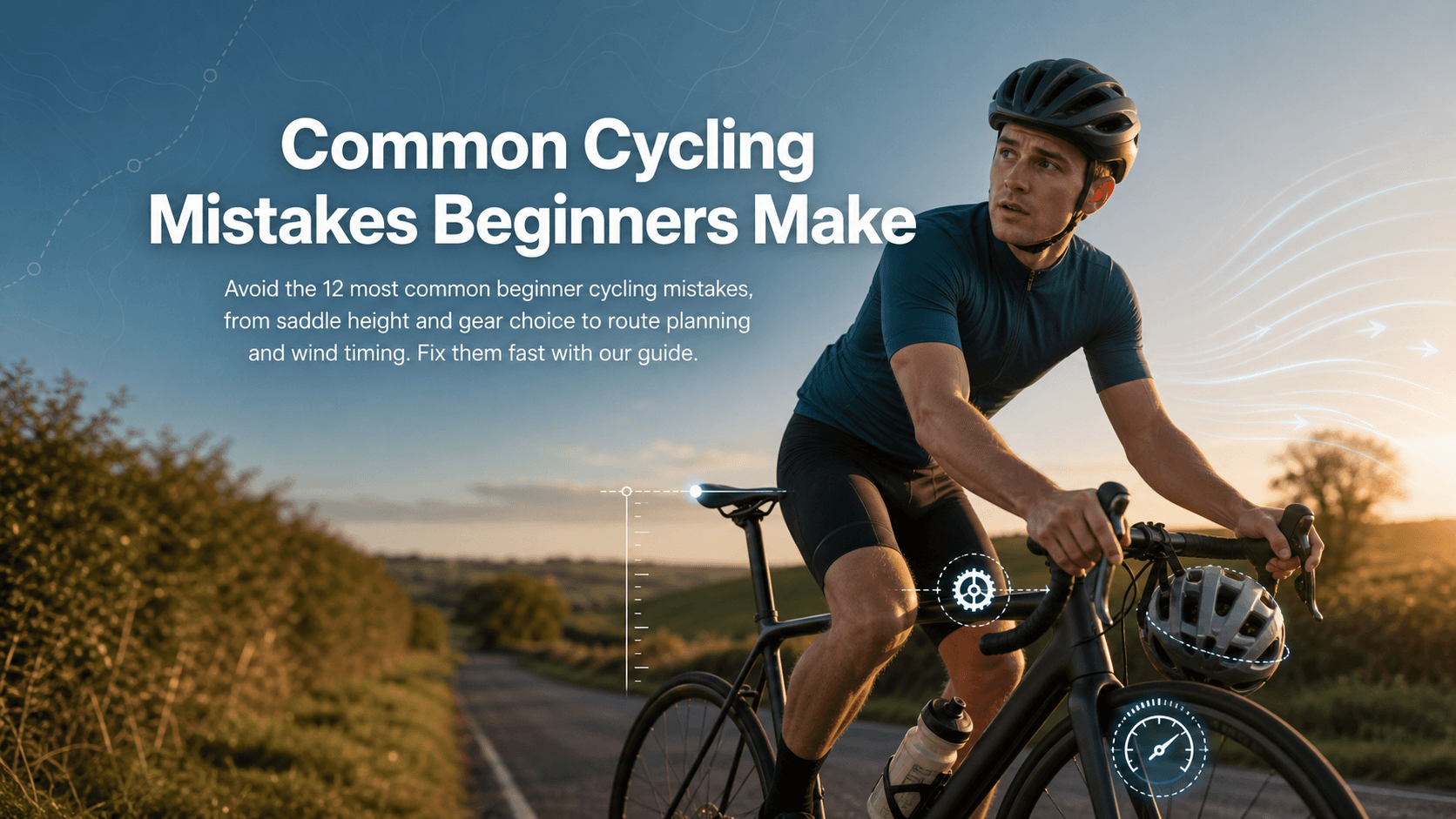
Common Cycling Mistakes Beginners Make
Avoid the 12 most common beginner cycling mistakes, from saddle height and gear choice to route planning and wind timing. Fix them fast with our guide.
You plan the ride, you're excited, you roll out, and within 20 minutes something goes wrong. Maybe your legs are screaming on the first climb, or you're getting soaked by rain that wasn't forecast, or your saddle is grinding you down by kilometre 15. Sound familiar?
Most beginner cyclists don't lack fitness or motivation. They're just making a handful of very fixable mistakes that stack on top of each other and make every ride feel harder than it should be. Fix the right things in the right order and cycling genuinely transforms.
Here are 12 common mistakes new cyclists make, including one that almost nobody talks about but that quietly ruins more rides than any of the others.
1. Saddle too low (the classic bike fit mistake)
According to Cycling UK, a saddle that's too low is one of the most frequent mistakes made by new cyclists. The reason is understandable: when you're nervous about falling off, you want to be able to put both feet flat on the ground at a stop. The problem is that if your saddle is set for standing, it's set far too low for pedalling.
A saddle that's too low puts your knee under constant stress through each pedal stroke and kills your efficiency. You want a slight bend in the knee (roughly 25 to 35 degrees) at the bottom of the stroke, not a deep crouch.
Do this instead: Sit on the bike and drop one heel onto the pedal at the six o'clock position. If your leg is dead straight, your saddle is roughly right. If your hips are rocking as you pedal, drop it a few millimetres. If you want precision, a local bike shop can do a proper fit in under an hour, it's worth every penny.
2. Mashing heavy gears instead of spinning
This is the mashing problem. You hit a mild incline, you stay in a big gear, you grind. It feels productive. It isn't. Pushing a huge gear at a slow cadence (below 60 rpm) puts enormous stress on your joints and burns through your energy reserves far faster than a higher cadence with a lighter gear.
A smooth, efficient cadence sits somewhere in the range of 80 to 90 rpm for most cyclists. Cycling UK includes incorrect gear use in their list of the 12 biggest beginner mistakes, specifically noting cadence and the importance of shifting before climbs.
Do this instead: Shift down to an easier gear before you need to. Keep your legs spinning rather than grinding. If you don't have a cadence sensor, count your pedal strokes for 15 seconds and multiply by four, aim for somewhere around 20 strokes in those 15 seconds.
3. Ignoring safety basics: helmet fit, visibility, and braking
A helmet sitting on the back of your head does nothing to protect your forehead. It should sit level, roughly two fingers above your eyebrows, and the strap should form a Y-shape just below each ear. Give the chin strap a tug, if the helmet shifts significantly, it's too loose.
On braking: British Cycling's guidance (September 2025) states that you should apply both brakes when slowing, with the front brake slightly favoured in normal conditions. The front brake provides most of your stopping power. New riders often avoid it out of fear of going over the bars, but the real skill is learning to use it progressively, not grabbing it suddenly.
Do this instead: Practice braking in a quiet car park. Apply both brakes smoothly and progressively. Before corners, always brake while the bike is upright, not mid-lean. Get a pair of bright lights for both front and rear, even in daylight.
4. Wearing the wrong kit (specifically: underwear under your shorts)
This one causes genuine suffering. Padded cycling shorts are designed to be worn directly against the skin. The chamois pad sits against you with no seams in between. Wearing normal underwear underneath adds seams exactly where friction is highest, and the result after a 40-minute ride is memorable in the worst possible way.
Do this instead: Cycling shorts go on without underwear. Full stop. If you're riding in cold weather, layer on top, not underneath. And if you feel any hotspots developing mid-ride, take note, adjust saddle height, tilt, or shorts before the next ride rather than grinding through it.
5. Skipping the pre-ride maintenance check
A flat tyre five kilometres from home because you rolled out on 40 psi when your tyre wanted 80 is deeply avoidable. According to British Cycling's ultimate guide to tyre pressure (February 2025), tyre pressure directly affects rolling resistance, grip, handling, and ride comfort, not just puncture risk.
The mistake most beginners make is either ignoring tyre pressure entirely or pumping to the maximum PSI printed on the sidewall. The sidewall figure is the maximum, not the target. Your actual ideal pressure depends on your weight, tyre width, and riding surface.
A basic pre-ride checklist takes under two minutes:
- Tyres: check pressure and inspect for obvious cuts or debris
- Brakes: squeeze both levers firmly, they should feel solid before hitting the bar
- Quick-release skewers or thru-axles: make sure wheels are properly secured
- Chain: a quick visual to confirm it's on the ring and lubricated
Do this instead: Build the habit of running through this list every time you go out. It takes 90 seconds and saves you from a significant proportion of ride-ruining mechanical issues. For a broader view of cycling apps for planning rides, pairing a reliable pre-ride check with smart planning tools is the foundation of consistent riding.
6. Pushing too hard, too soon
New cyclists tend to treat every ride like a test. Every session is at maximum effort, every climb is a personal battle. The body doesn't build fitness that way, it builds fitness by adapting to repeated stress with adequate recovery between sessions.
The 80/20 rule (sometimes called polarised training) is well-established: roughly 80% of your riding should feel genuinely easy, with only around 20% at harder intensities. Easy means you could hold a conversation. If you're breathing too hard to chat, you're probably going too hard for a base-building ride.
Do this instead: For your first few weeks, aim for three shorter rides at genuinely easy pace rather than two hard ones. Increase weekly duration by no more than about 10% each week to give your body time to adapt. The training-focused guides on the Tailwind GPS blog are a good reference for structuring this kind of progressive approach.
7. Getting nutrition and hydration wrong (and bonking as a result)
Waiting until you're thirsty to drink is too late. Waiting until you're hungry to eat on a long ride is definitely too late. Dehydration and glycogen depletion (the dreaded "bonk") can creep up on you without warning, and by the time you feel the effects, your ride is already in trouble.
On rides longer than an hour, aim to drink roughly 500–750ml per hour depending on temperature and effort. For anything over 90 minutes, start taking on carbohydrates before you feel hungry — around 30–60g of carbs per hour is a sensible starting point. That might be a gel, a banana, an energy bar, or real food if you prefer it.
Do this instead: Set a timer on your head unit to remind you to eat and drink every 20 minutes. It sounds overly simple, but it works. Plan your nutrition before you leave, not when you're already an hour in and starting to feel hollow. If you're riding with a club group, don't skip the café stop just to save time — that's often where experienced riders quietly sort themselves out for the second half.
8. Ignoring the wind — and paying for it
New cyclists quickly learn that hills are hard. What takes a little longer to learn is that wind is often harder. A stiff headwind can double your perceived effort on a flat road, turning what looks like an easy route into a sufferfest. Heading out with a strong tailwind feels great — until you turn around and realise you have to ride home into it.
Experienced riders think about wind direction before they leave. They plan routes that work with prevailing conditions, not against them. They know that leaving earlier or later can make a significant difference to which direction the wind hits them on the exposed sections.
Do this instead: Before you head out, check not just whether it's windy, but where the wind is coming from relative to your route. A tool like Tailwind GPS does exactly this — it analyses wind conditions along your actual route, hour by hour, and gives you a simple score so you know whether conditions are working for you or against you. It's the difference between a ride that flows and one that grinds.
9. Not wearing the right kit for the conditions
Getting cold and wet on a ride isn't just uncomfortable — it can end your session early and leave you dreading the next one. New cyclists often underdress on cool mornings or overdress on mild days, and either way the ride suffers.
The general rule is to dress as if it's about 10 degrees warmer than it actually is, because you'll warm up quickly once you're moving. But descents, exposed sections, and early morning starts can all catch you out if you haven't thought ahead.
Do this instead: Check the temperature and rain forecast for the full duration of your ride, not just at the start. A gilet or lightweight packable jacket takes up almost no space and can save a ride. If there's any chance of rain in the second half, bring a layer — you'll be grateful you did.
10. Trying to do too much too soon
There's a particular kind of ambition that affects new cyclists: the urge to sign up for a 100-mile sportive after three weeks of riding. It's understandable. Cycling is exciting, the community is encouraging, and the events look achievable on paper. But building the fitness, resilience and bike-handling confidence to enjoy a big event takes time — and rushing it usually leads to injury, burnout, or a miserable day out.
Do this instead: Pick a goal that's three to four months away rather than three weeks. Give yourself time to build a base, experiment with nutrition, sort your bike fit, and actually enjoy the process of getting fitter. The riders who stick with cycling long-term are almost always the ones who built gradually and fell in love with the training, not just the events.
Every experienced cyclist has made most of these mistakes. The difference is that they learned from them — and kept riding anyway. Get the basics right early, plan your rides with a bit more thought, and you'll spend far more time enjoying the road and far less time suffering through it unnecessarily.
Stop guessing the wind
See route-specific wind scores before you roll out — free on up to three routes.
Related posts
Clipless Pedals vs. Flat Pedals
Clipless or flat pedals for road cycling? Compare both options across safety, efficiency and skill level to find the right choice for your riding stage.
·8 min read
How to Choose the Right Road Bike
Endurance, race, gravel or aero? Use this practical guide to choose the right road bike category for your riding style, terrain, and goals.
·11 min read
Must-Have Gear When Getting Into Road Cycling
New to road cycling? Here are the essential items you actually need to start riding safely and comfortably in the UK, plus what to skip until later.
·10 min read