Clipless Pedals vs. Flat Pedals
Clipless or flat pedals for road cycling? Compare both options across safety, efficiency and skill level to find the right choice for your riding stage.
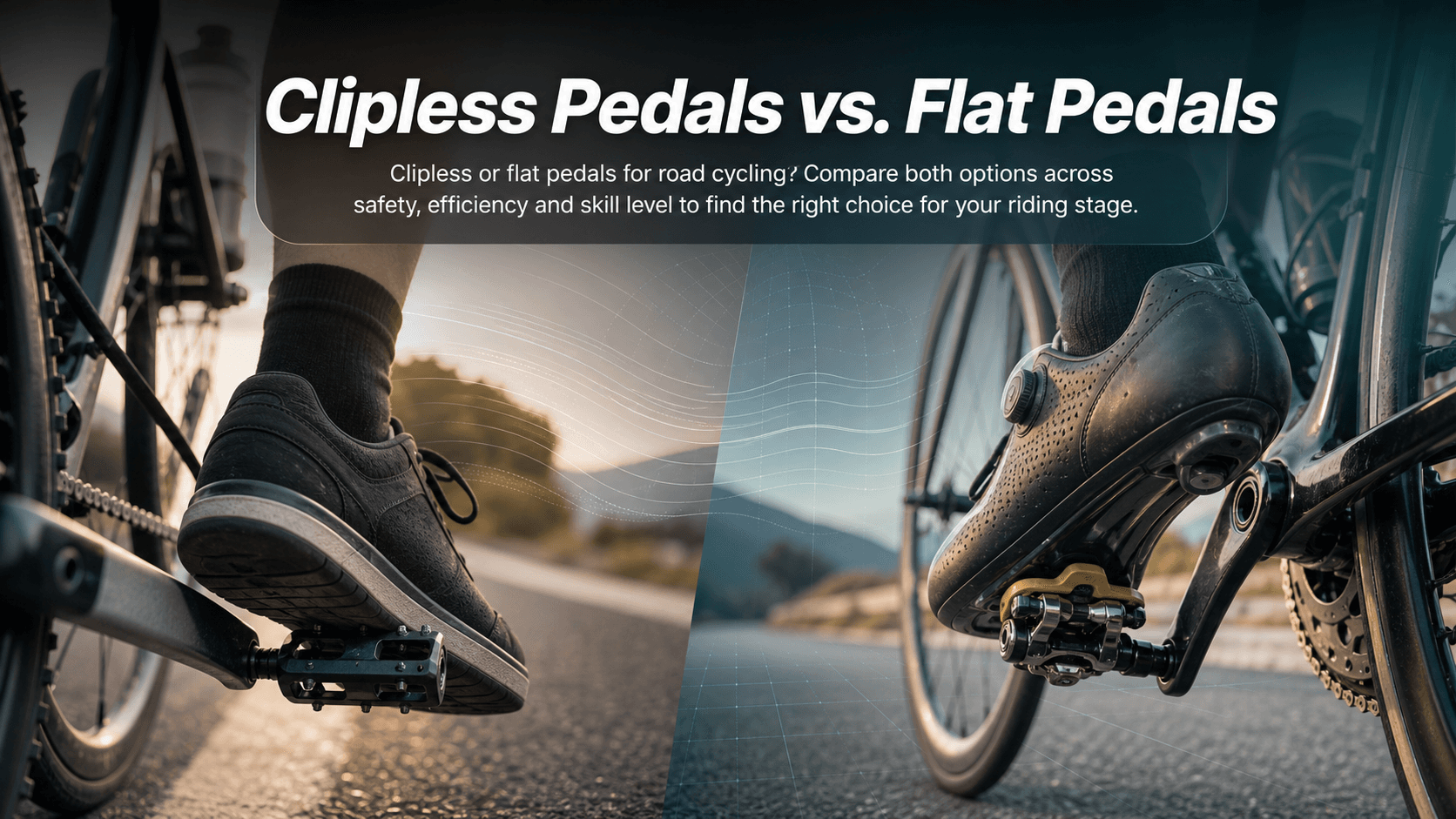
You've just bought your first road bike, or maybe you've been riding a few months and someone at a café stop told you it's time to "go clipless". Now you're wondering whether they're right, whether it's dangerous, and whether flat pedals are secretly holding you back.
The honest answer? It depends entirely on where you are as a rider. This guide cuts through the noise so you can make the right call for your situation.
Quick answer: don't overthink it
Most beginners on road bikes should start with flat (platform) pedals. Full stop.
Flats let you put a foot down instantly at traffic lights, at junctions, and any time your balance wobbles. That freedom matters enormously when you're still getting comfortable with road riding. As BikeRadar puts it, "new cyclists may benefit from spending some time on flats as they get used to riding a road bike... they can put a foot down easily... without having to learn to clip out."
Clipless pedals are a sensible upgrade once you can start and stop consistently without panic, and once you're riding long or hard enough to care about foot security and power. If you're genuinely unsure which camp you're in right now, the safest path is: flats to build confidence, then transition to clipless when your unclipping reflex feels automatic.
What "clipless" actually means (and why beginners get nervous)
The name is famously confusing. Clipless pedals do involve clipping in, a cleat on the sole of your shoe snaps into a mechanism on the pedal. The name comes from the fact that they replaced older toe-clip-and-strap systems. So yes, you clip in. No, the name doesn't help.
For road cycling, there are two broad systems worth knowing about:
- Three-bolt road cleats (like Shimano SPD-SL, Look KEO): large plastic cleats that sit exposed under the shoe. Excellent power transfer, but terrible for walking. Clipping out requires a deliberate heel-twist.
- Two-bolt MTB-style cleats (like Shimano SPD): smaller, recessed into the sole. Much easier to walk in, easier to find entry, and generally more forgiving to learn on. Popular with commuters and beginners for good reason.
The anxiety beginners feel is real and specific: forgetting to unclip at a stop and toppling sideways in slow motion while everyone watches. BikeRadar acknowledges this gracefully, "we've all come to a stop... and keeled over in the road. It's a rite of passage for road cyclists." The risk is recoverable, but it's concentrated in the early weeks.
Flat pedals for beginners: the real advantages
Flat pedals get dismissed as "beginner kit", but that framing is backwards. They're the right tool for a specific stage of riding, not a mark of inexperience.
The biggest practical advantage is what BikeRadar describes plainly: "Riding flats makes stopping and putting a foot down that much easier than clipless pedals." If you ride in a city, commute through traffic, or are still building confidence at junctions, that ease is worth a lot. You're not managing an unclipping manoeuvre at the same moment you're judging a gap in traffic.
Flats also remove one variable while you're learning. Road cycling already asks you to manage gear shifts, braking distances, cornering on skinny tyres, group riding etiquette, and route awareness. Removing the need to think about cleat release means you can focus on the skills that actually make you a better rider.
Cost is a factor too. Getting into clipless properly means buying pedals and dedicated cycling shoes, a reasonable outlay, but one you can defer. With flats, your existing trainers work fine.
There's a skill-building argument here as well. Riding flats teaches you to maintain a stable foot position without relying on being locked in. Some coaches actively recommend this before any clipless transition, precisely because it builds better pedalling mechanics.
Clipless pedals: when they help (and when they don't)
Once you've got your road-bike foundations sorted, clipless pedals offer a few genuine advantages.
The most-cited benefit is efficiency, but this deserves a precise answer, not a vague claim. Research referenced by BikeRadar found no measurable difference in pedalling efficiency between trainers on flat pedals and clipless cycling shoes at lower intensities. The same test on a stationary bike showed near-identical results for steady riding. Where clipless pedals do make a difference is at the harder end: an outdoor sprint test showed that clipped-in cycling shoes increased maximum power by an average of 16.6% over the trainer/flat pedal combination, while toe clips and straps added 9.7%.
So if you're riding long sportives, hammering intervals, or doing group rides where you need to respond to surges, clipless gives you something real. If you're riding at a relaxed pace on shorter routes, the efficiency gap barely exists.
The consistent foot position is another genuine benefit. Once clipped in, your foot sits in exactly the same place on the pedal every time, no micro-shifting, no hot spots building up on a three-hour ride.
The downsides for beginners are equally real. The learning curve is concentrated around unclipping, and the consequences of a missed unclip at a stop are embarrassing at best and injurious at worst. Setup sensitivity matters too, cleats positioned incorrectly can cause knee pain or IT band issues, which means a bike fit or at least careful cleat alignment is part of the deal. And if your ride involves stopping at a café, exploring on foot, or navigating a car park, road-specific cleats (three-bolt) make walking genuinely awkward.
Safety first: how to de-risk switching to clipless
If you decide to make the switch, the transition doesn't have to be stressful. Most people who fall over doing it failed to practice before heading into traffic.
Start with the release tension. Most clipless pedals have a small bolt (usually Allen key) that adjusts how much force is needed to twist out. Set it to the lowest (easiest) tension when you start. You can increase it later once the movement feels natural.
Before you ride anywhere with other road users, spend time on the bike in a stationary setting, leaning against a wall or standing on a quiet drive. Practise clipping in and clipping out repeatedly until it's genuinely automatic. The motion needs to be a reflex, not a thought process.
When you do ride on roads, adopt the "unclip early" approach at every stop: as soon as you see a red light or a junction ahead, unclip one foot and hold it ready. Don't wait until you're already slowing to a halt. This single habit prevents the vast majority of clipless falls.
For cleat choice, look for options with more float, the degree of rotational movement allowed before the cleat releases. More float reduces stress on your knees and makes accidental release harder to trigger accidentally. Shimano SPD cleats, for example, come in single-release and multi-release variants; the multi-release option disengages when you twist in multiple directions, which is more forgiving for beginners.
Check cleat wear regularly. Worn cleats can stick in the pedal or release unpredictably, neither is what you want approaching a busy junction.
Side-by-side: clipless vs flat pedals for road cycling
| Flat pedals | Clipless pedals | |
|---|---|---|
| Ease of stopping | Easy, instant foot-off | Requires deliberate unclip reflex |
| Learning curve | None | Moderate (2-4 weeks to feel natural) |
| Walking in shoes | Normal shoes, no problem | Depends on cleat type (SPD recessed = fine; SPD-SL exposed = awkward) |
| Efficiency (steady pace) | Equal to clipless | Equal to flats |
| Max power in a sprint | Baseline | Up to 16.6% higher |
| Setup cost | Low (no new shoes needed) | Moderate (pedals + shoes + cleats) |
| Risk for beginners | Low | Concentrated at stops; manageable with practice |
| Best for | Beginners, urban riding, short routes | Longer rides, group rides, harder efforts |
So which should you choose? A decision checklist
Choose flat pedals if:
- You're still getting comfortable on a road bike
- You ride in busy urban areas with frequent stops and unpredictable traffic
- You need to dab a foot often (hills, tight corners, starts)
- Most of your rides are under an hour at a relaxed pace
- You want to keep things simple and inexpensive right now
Choose clipless when:
- Your starts and stops feel consistent and controlled
- You're riding longer or harder (sportives, group rides, interval training)
- You want a more secure foot connection and consistent power delivery
- You're comfortable investing in shoes and taking a couple of weeks to adapt
- You ride mostly on quiet roads or can practise unclipping before hitting traffic
A middle-ground option: SPD-style two-bolt pedals are double-sided and easier to clip into than road-specific single-sided pedals. Some models even work with regular trainers on one side and allow clipping in on the other, useful for someone who wants to try clipless gradually without full commitment.
If you do go clipless: a four-phase progression
Rushing the transition is where most people run into problems. This progression takes roughly four to six weeks and significantly reduces your risk of a slow-motion topple at a junction.
Phase 1, Build flat-pedal foundations. Spend your first weeks on flats learning smooth cadence, controlled braking, and confident starts and stops. Understand where your foot naturally sits on the pedal. This isn't wasted time, it's the foundation that makes clipless easier.
Phase 2, Off-bike practice. Buy your pedals and shoes, then spend time clipping in and out while stationary. Lean against a wall, clip both feet in, then unclip one side repeatedly. Do this for 15-20 minutes across a few sessions until the twist-out motion requires zero conscious thought.
Phase 3, Quiet roads only. Do your first clipless rides on roads with minimal traffic and few stops. Car parks, cycle paths, and quiet residential streets are ideal. Use the "unclip early" approach at every potential stop, start preparing well before you need to halt.
Phase 4, Fine-tune and commit. After a few rides, assess cleat position. If you're experiencing any knee discomfort, move the cleat slightly rearward. Adjust float to suit your natural foot angle. Once this is dialled in, you can start riding your normal routes.
Most riders feel genuinely comfortable within two to four weeks of consistent riding. The occasional reflexive-unclip failure can still happen after months, especially on unfamiliar routes, the antidote is always the same: unclip early, prepare ahead.
FAQs
How long does it take to get comfortable with clipless pedals?
For most people, two to four weeks of regular riding. The mechanical reflex of unclipping comes quickly; the confidence around traffic takes a little longer. Practising in a stationary setting before hitting roads cuts this timeline significantly.
Are clipless pedals more dangerous for beginners?
The risk is real but specific. Falls tend to happen at zero speed when someone forgets to unclip before stopping, they're embarrassing rather than catastrophic in most cases. The risk drops sharply once the unclip reflex is automatic. Riding with low release tension and practising extensively before roads are involved puts the risk in perspective.
Can I walk normally in clipless shoes?
It depends on the cleat system. SPD-style two-bolt cleats are recessed into the sole, so you can walk fairly naturally in SPD shoes. Three-bolt road cleats (SPD-SL, Look) are large, exposed, and designed purely for pedalling, walking on them is awkward and wears them quickly. If walkability matters to your rides, SPD is the right system.
Do I need stiff-soled cycling shoes?
Stiffer soles do transfer power more efficiently to the pedal, but this matters most at higher intensities. For beginners using flats, standard trainers with a reasonably firm sole work fine. For clipless riding, a dedicated cycling shoe helps, the cleat mounting and sole stiffness are part of the system working as designed.
Which cleat system is best for beginners: SPD or SPD-SL?
SPD (two-bolt) is the beginner-friendly choice. The cleats are recessed, the shoes are walkable, the pedals are usually double-sided (easier to clip into), and the release action is forgiving. SPD-SL (three-bolt) offers marginally better power transfer at the high end but punishes beginners with difficult entry, poor walkability, and a single-sided pedal surface that's harder to locate quickly. Start with SPD.
Confidence first, then performance
The pedal debate gets treated like a philosophical argument in some corners of cycling, but it's really just a timing question. Flat pedals give you something genuinely valuable at the start: freedom from one more variable while you're still building control. Clipless pedals give you something valuable later: security, consistent foot placement, and the power gains that show up when you're riding hard enough for them to matter.
Neither is wrong. The mistake is rushing the transition before the foundations are solid.
Good riding decisions tend to follow the same logic across the board. Just as you'd want to know the wind conditions along your actual route before committing to a big day out (rather than guessing from a generic forecast), choosing the right pedal setup means looking at your actual riding context: how often do you stop, how confident are you at traffic lights, and how far and hard are you riding? Answer those questions honestly and the choice makes itself.
When you're ready to start planning rides with the same level of clarity, Tailwind GPS wind scores for your Strava routes can take the guesswork out of when to go and which route to ride.
Start planning rides
Connect Strava and score your regular routes while you build pedal confidence.
Related posts
Common Cycling Mistakes Beginners Make
Avoid the 12 most common beginner cycling mistakes, from saddle height and gear choice to route planning and wind timing. Fix them fast with our guide.
·7 min read
How to Choose the Right Road Bike
Endurance, race, gravel or aero? Use this practical guide to choose the right road bike category for your riding style, terrain, and goals.
·11 min read
Must-Have Gear When Getting Into Road Cycling
New to road cycling? Here are the essential items you actually need to start riding safely and comfortably in the UK, plus what to skip until later.
·10 min read