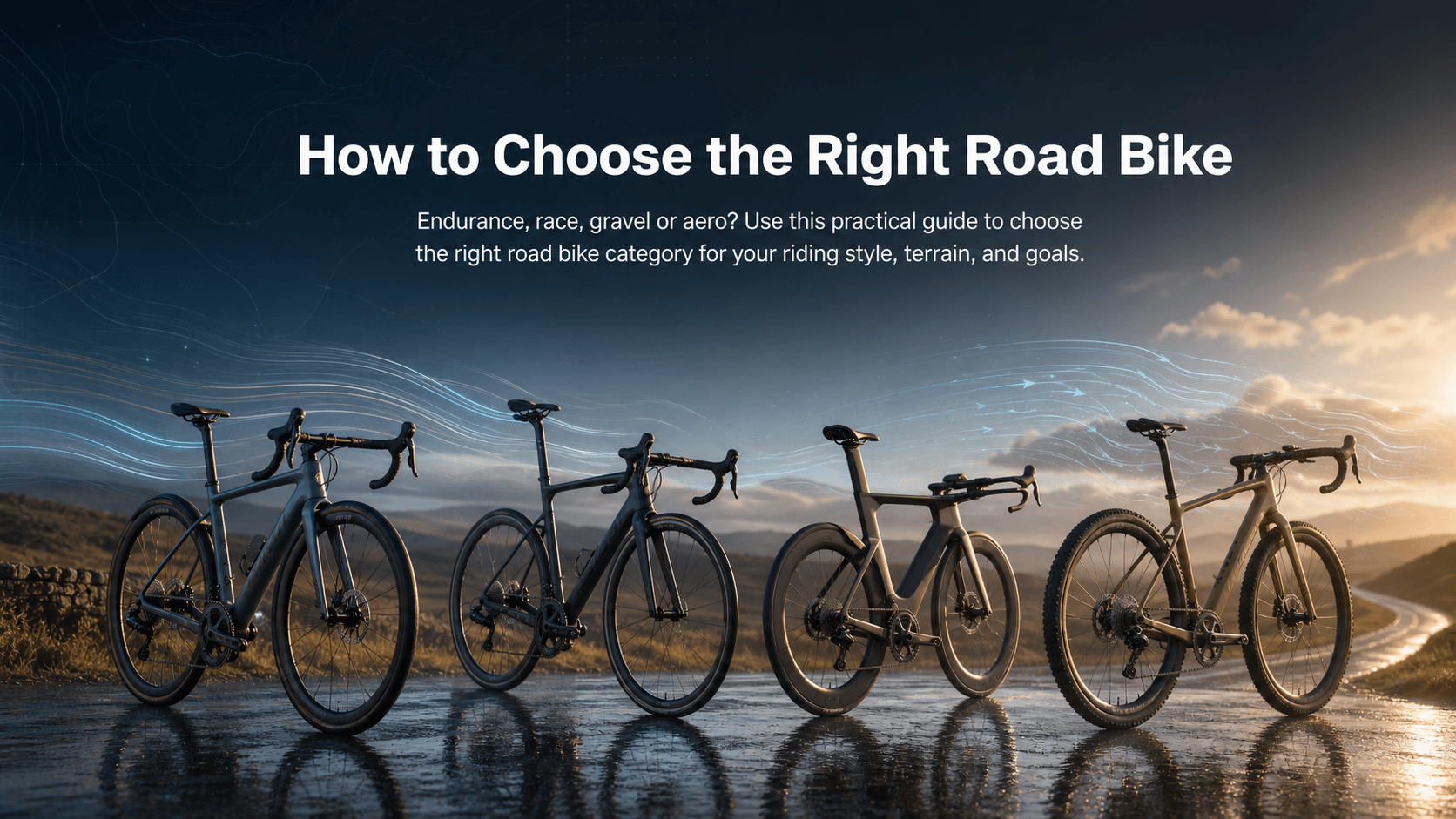
How to Choose the Right Road Bike
Endurance, race, gravel or aero? Use this practical guide to choose the right road bike category for your riding style, terrain, and goals.
You've decided to buy a new road bike. You've got a budget, a vague sense of what you want, and about fifteen tabs open comparing carbon frames you're not sure you actually need. Sound familiar?
The problem isn't that there aren't enough options. The problem is that four fundamentally different bike categories all get marketed under the same broad label of "road bike," and the differences between them genuinely affect how every single ride feels. Pick the wrong one and you'll spend three years wondering why your back aches on club runs, or why your supposedly fast aero machine gets battered on the lanes you actually ride.
This guide cuts through it. By the end, you'll know which category suits your riding, what to check on the spec sheet, and why the conditions on your specific route matter just as much as the bike in your garage.
Quick answer: which bike should you buy? (3 questions)
If you want a fast answer before diving into the detail, run through these three questions:
- What's your main terrain? Tarmac only, or do you regularly ride gravel, forest tracks, or rough lanes?
- What's your priority? All-day comfort, outright speed, or the flexibility to do both?
- What's your goal? Sportives and club rides, race wins and personal bests, gravel events, or a mix?
Here's what those answers typically point to:
- Mostly tarmac + comfort + sportives/club rides = endurance road bike
- Mostly tarmac + speed + racing/PBs = race road bike
- Mostly tarmac + speed + flat fast routes = aero road bike
- Mixed terrain + versatility + gravel events = gravel bike
If you answered "a bit of everything" to most of those, you might actually be looking at an all-road or adventure crossover. These blur the lines deliberately and are worth considering if you genuinely can't commit to one category.
Bike categories in plain English
Endurance road bikes
Designed for long days in the saddle. According to BikeRadar's 2026 buyers' guide, endurance road bikes prioritise comfort and long-distance riding through a more upright, relaxed geometry. Alpkit's 2026 buying guide backs this up: longer wheelbases and greater tyre clearance are defining features. The result is a bike that absorbs road buzz, keeps your neck and back in a manageable position over four hours, and can typically run 32–38 mm tyres depending on the frame.
You won't be slower than you think on an endurance bike. On British roads, which are rarely billiard smooth, that extra compliance often means more consistent power output.
Race road bikes
A race bike puts you in a lower, more aggressive position. The geometry prioritises stiffness and responsiveness over cushioning. Stack is lower, reach is longer, and the handling is snappier. If you're lining up for crits, road races, or chasing segment times, that responsiveness matters. If you're doing a 200 km audax on Saturday, you'll feel it in your hips by kilometre 130.
Aero road bikes
Aero bikes share much of the race geometry but are built around reducing drag: dropped tube profiles, integrated cockpits, and wheel cutouts are all designed to cut through air more efficiently. The speed gains are real above roughly 35–38 km/h sustained, but below that the advantages narrow considerably. Aero bikes tend to be slightly heavier than a pure climber's race bike, and the integrated components can make fit adjustments less forgiving.
Gravel bikes
Gravel bikes use a slacker, longer wheelbase to give you stability on loose or unpredictable surfaces. As Canyon's April 2024 breakdown explains, tyre clearance is the defining difference between endurance and gravel bikes: gravel frames typically accommodate 40–50 mm tyres, sometimes wider, and many offer 650b wheel compatibility for even more rubber. They usually come with threaded bottom brackets, more mounting points for bags and guards, and gearing designed around sustained low-cadence climbing rather than high-speed sprints.
The big 4 decision factors
1. Geometry and your position
Stack and reach are the two measurements that tell you most about how a bike will fit. Stack is the vertical distance from the bottom bracket to the head tube; reach is the horizontal distance. A high stack puts you more upright. A long reach stretches you out.
In practice: if you've ever come home from a long ride with a stiff neck or shoulder pain, you likely need more stack. If you feel cramped and can't generate power through the pedals, reach might be too short. Endurance bikes run higher stack numbers; race and aero bikes run longer, lower positions. Knowing your preference before you buy saves a lot of grief with spacers and stems.
2. Tyre clearance and real-world capability
The maximum tyre clearance on a frame determines the widest tyre you can actually run. This matters for three reasons: comfort (wider tyres absorb more road vibration at lower pressures), puncture resilience (more volume = more margin), and all-road capability.
A race bike that clears 28 mm is limited to smooth tarmac at its best. An endurance bike that clears 32–35 mm opens up chip-seal, rough lanes, and light gravel. A gravel bike clearing 45 mm or more takes you into forest tracks and byways. Cyclist's February 2025 feature on wider road tyres explains why wider tyres can roll faster in real-world conditions: the tyre deforms differently as it contacts the road, reducing the energy loss that narrower high-pressure tyres can create on imperfect surfaces. The key caveat: tyre width interacts with internal rim width, so always check rim compatibility before buying tyres.
3. Drivetrain gearing range
For flat, fast riding or racing, you want tight, close-ratio gearing (small jumps between gears, big chainring up front). For long climbs or rough terrain, you need bailout gears: a compact or sub-compact chainset with a wide-range cassette (32t or bigger at the back).
Race bikes tend toward 2x setups with close-ratio cassettes. Gravel bikes increasingly use 1x drivetrains with a wide-range cassette (10–44t or similar) to simplify muddy operation and reduce weight. Endurance bikes sit in the middle: usually 2x with a compact or semi-compact chainset and a cassette giving you enough range for British hills without sacrificing top-end speed.
Before buying, calculate the lowest gear ratio you'll need for your hardest regular climb. If the bike's spec doesn't cover it comfortably, budget for a cassette swap.
4. Handling and day-after-day fatigue
Harsh, sharp-handling bikes are brilliant for a two-hour crit. Ridden every day over mixed terrain, they fatigue you faster and demand more active input on descents. Endurance and gravel bikes are deliberately more stable and forgiving. If you're putting in 10–14 hours a week across multiple ride types, that stability pays dividends in consistency, not just comfort.
Side-by-side comparison: the four categories at a glance
Bear in mind that brands don't always follow consistent labelling. The ranges below reflect typical design intent rather than rigid rules.
| Category | Typical tyre clearance | Common tyre sizes | Geometry intent | Gearing tendency | Best for |
|---|---|---|---|---|---|
| Endurance | 32–38 mm | 28–35 mm | Higher stack, relaxed | 2x compact, mid-range cassette | Club rides, sportives, all-day comfort |
| Race | 25–30 mm | 25–28 mm | Low stack, long reach | 2x close-ratio | Road racing, fast group rides, segment efforts |
| Aero | 28–32 mm | 25–30 mm | Low/long, integrated | 2x close-ratio | Flat fast routes, time savings above ~35 km/h |
| Gravel | 40–55 mm+ | 38–50 mm (700c) or wider (650b) | Slack, long wheelbase | 1x wide-range or 2x compact | Mixed terrain, gravel events, bikepacking |
Race vs aero: do you need an aero bike, or just an aero position?
This is where a lot of money gets spent on marginal gains that don't materialise.
road.cc's February 2025 test compared a modern aero bike against an older bike where the rider's position had been carefully dialled in, and concluded that rider position and cockpit setup can outweigh the benefits of a new aero frame. That's not a niche finding. Aerodynamic drag is dominated by the rider's body, not the frame. If your position on your current bike is upright, a new aero frame won't rescue the situation.
Run through this quick checklist before committing to an aero bike:
- Do most of your weekly rides average above 32–35 km/h on the flat?
- Can you hold a low, aggressive position comfortably for 60–90 minutes?
- Are you riding mostly flat or rolling terrain rather than hilly routes?
- Are you prepared to live with an integrated cockpit that limits fit adjustability?
If you answered yes to all four, an aero bike will likely give you real gains. If two or more answers are no, improving your position on an endurance or race bike will probably do more for your times than a new frame.
At speeds around 30–35 km/h, aerodynamic drag accounts for roughly 70–80% of a cyclist's total resistance. A 10-watt saving at the handlebar position can be worth more than 20–30 watts of frame aero improvement. Get the position right first.
Endurance vs gravel: the crossover trap
If your "gravel" riding is mostly smooth forest tracks with the occasional rough patch, an endurance bike with 32–35 mm tyres can handle it without drama. You'll be faster on the tarmac sections, lighter overall, and more comfortable on longer road segments.
But if your off-road riding regularly involves wet, rutted tracks, loose stone, or bikepacking loads, gravel geometry becomes genuinely important. A longer wheelbase and slacker head angle give you confidence on unpredictable surfaces. Trying to ride those conditions on an endurance bike with maxed-out tyres is tiring and, on descents, sketchy.
As Canyon's April 2024 guide notes, the differences extend beyond tyres: wheel size options (700c vs 650b), brake lever reach for wet-glove control, and mounting points for mudguards and bags all factor in. If you'll use them, these details matter.
A simple rule: if you're spending more than 30–40% of your riding time off-road, buy the gravel bike. If it's occasional, an endurance bike with an open tyre clearance spec is probably enough.
Tyres and pressure: making the right category feel right
Whatever bike you buy, tyre choice and pressure will transform how it rides. Cyclist's February 2025 feature on wider tyres makes clear that the old assumption (narrower = faster) no longer holds on real roads. A 30 mm tyre run at the right pressure can roll faster than a 25 mm tyre at high pressure on chip-seal, because the smaller tyre deforms more aggressively as it rolls.
A quick surface-to-tyre width cheat sheet:
- Smooth tarmac only: 25–28 mm at 80–90 psi (check rim width compatibility)
- Mixed tarmac and chip-seal: 28–32 mm at 65–80 psi
- Mixed tarmac and light gravel: 32–38 mm at 45–65 psi
- Gravel and off-road: 40 mm+ at 30–45 psi (tubeless recommended)
For competitive riders, one point is worth repeating: if your tyre-pressure setup is so harsh that it makes you sit up on rough sections, you've lost any aero benefit. A slightly wider tyre at a lower pressure that lets you stay in the drops consistently will be faster than a narrow tyre that punishes you off the saddle every time the road roughens.
Always match tyre width to your rim's internal width. The general guideline is that the tyre width should be 1.4–2.5 times the internal rim width for optimal performance and safety.
How Tailwind GPS changes the decision
Here's something most bike guides skip entirely: even the right bike for your riding style can deliver a terrible session if the conditions on your specific route don't match the effort you're planning.
An aero bike on a flat circuit in a 25 km/h cross-headwind is slower and harder than an endurance bike on a hilly loop with a genuine tailwind for the second half. A gravel bike on dry, steady hardpack is a completely different experience to the same bike on wet clay after three days of rain. Buying the right category is step one. Matching the bike to the right riding window is step two, and most cyclists skip it entirely.
This is exactly what Tailwind GPS is built for. Rather than showing you a generic weather forecast, it analyses conditions along every kilometre of your actual route, sampling wind direction, speed, temperature, and rain probability hour by hour. Every route gets a Tailwind Score from 0–100 for each departure hour, so you can see at a glance whether 7am or 9am on Saturday is the better window for your planned effort.
For subscribers, that planning window extends to 14 days ahead, which is genuinely useful when you're building a week around a key session or a group ride. Free accounts cover up to three saved routes with three-day forecasts.
Here's how it maps to your bike category:
- Endurance rides: look for departure hours with low wind and dry conditions. You want a comfortable, consistent effort, not a battle from kilometre five.
- Aero/flat fast efforts: a score above 70 on a flat route means conditions are working in your favour. Below 50, you're fighting physics regardless of your frame.
- Race PB windows: check hourly scores across the week and pick the slot where the wind aligns with your route direction. A 10-point score difference can translate to several minutes over 60 km.
- Gravel sessions: prioritise dry conditions for traction. The route-level wind and rain forecasting shows exactly which part of your ride sees rain if a front is passing through.
The platform integrates with Strava, so your regular routes are already there. You can also build or import routes via GPX. For club rides, the route sharing and group planning tools let you share the best departure window with your whole group rather than everyone independently checking different apps.
For anyone training with structure, planning harder and easier days around wind makes a real difference: deliberately choosing headwind mornings for training load and tailwind windows for recovery or PB efforts is the kind of marginal gain that doesn't cost anything.
Buying checklist
Print this off, take it to the bike shop, or go through it on the manufacturer's spec sheet.
Geometry and fit
- Check stack and reach numbers and compare against your current or test-ride bike
- Confirm stem length and angle are adjustable within the range you need
- Check bar width options match your shoulder width (endurance bikes often spec wider bars)
Tyre clearance
- Confirm maximum tyre clearance with mudguard clearance in mind (add ~5 mm)
- Check whether the clearance works with 700c and/or 650b (gravel bikes)
- Decide what tyres you'll actually buy before committing to the frame
Gearing
- Calculate the lowest gear you need for your hardest local climb
- Check chainset size and maximum cassette size compatibility with the groupset
- Consider whether a 1x or 2x setup fits your riding mix
Practicality
- Does the frame have mudguard mounts if you ride through winter?
- Are there enough bottle cage and bag mounts for your typical ride length?
- Check brake type (rim vs disc) and whether it suits your riding conditions
Ride planning
- Save your key routes on Tailwind GPS before you buy
- Check the Tailwind Score for your typical ride windows to understand what conditions you're actually riding in
- Use 14-day forecasting (subscriber tier) to plan key sessions around the best available weather window
Frequently asked questions
Is an endurance bike good enough for racing?
Yes, in most contexts. Club races, sportives, and gran fondos are routinely won on endurance geometry. The difference between an endurance and race bike in a club ride scenario is smaller than most marketing suggests. Where race geometry gives a clearer advantage is in criteriums and fast technical circuits where sharp, responsive handling matters.
Can I race on a gravel bike?
You can enter most events on a gravel bike, but you'll give up speed on tarmac compared to a road bike. Swapping to 700c x 32–35 mm road-oriented tyres helps significantly. The handling and weight penalty remains. For mixed-surface races (gravel series, cyclocross-adjacent events), a gravel bike is the right tool. For pure road racing, it's a compromise.
Do I need an aero bike if I'm not riding fast every time?
Probably not. The aerodynamic gains from a frame become relevant at sustained speeds above roughly 35 km/h on flat terrain. Below that, the weight penalty and fit constraints of many aero bikes are a bigger factor than the drag savings. If most of your riding is at 25–30 km/h on mixed terrain, an endurance bike with a good position will serve you better.
What tyre width should I run on a road bike?
For smooth tarmac, 25–28 mm is still fast and practical. For typical British roads with chip-seal and variable surfaces, 28–32 mm is the sweet spot: lower rolling resistance on rough surfaces without the handling compromise of very wide tyres. Endurance bikes specced at 32 mm are increasingly common for good reason.
How do I choose between 28–30 mm and 32 mm tyres?
28–30 mm makes sense if most of your riding is on well-maintained tarmac and you want a slightly more nimble feel. Go to 32 mm if you ride a lot of rough tarmac, chip-seal, or light gravel, or if you want more puncture protection on longer unsupported rides. The rolling resistance difference between a quality 28 mm and 32 mm tyre on real roads is negligible; the comfort difference is not.
Save routes before you buy
Import your test-ride loops and check which departure windows suit your local terrain.
Related posts
Common Cycling Mistakes Beginners Make
Avoid the 12 most common beginner cycling mistakes, from saddle height and gear choice to route planning and wind timing. Fix them fast with our guide.
·7 min read
Clipless Pedals vs. Flat Pedals
Clipless or flat pedals for road cycling? Compare both options across safety, efficiency and skill level to find the right choice for your riding stage.
·8 min read
Must-Have Gear When Getting Into Road Cycling
New to road cycling? Here are the essential items you actually need to start riding safely and comfortably in the UK, plus what to skip until later.
·10 min read