How to Fuel Before, During & After Long Rides
Build a simple, evidence-based nutrition plan for long bike rides. Learn exact carb, sodium and protein targets to fuel performance and recover faster.
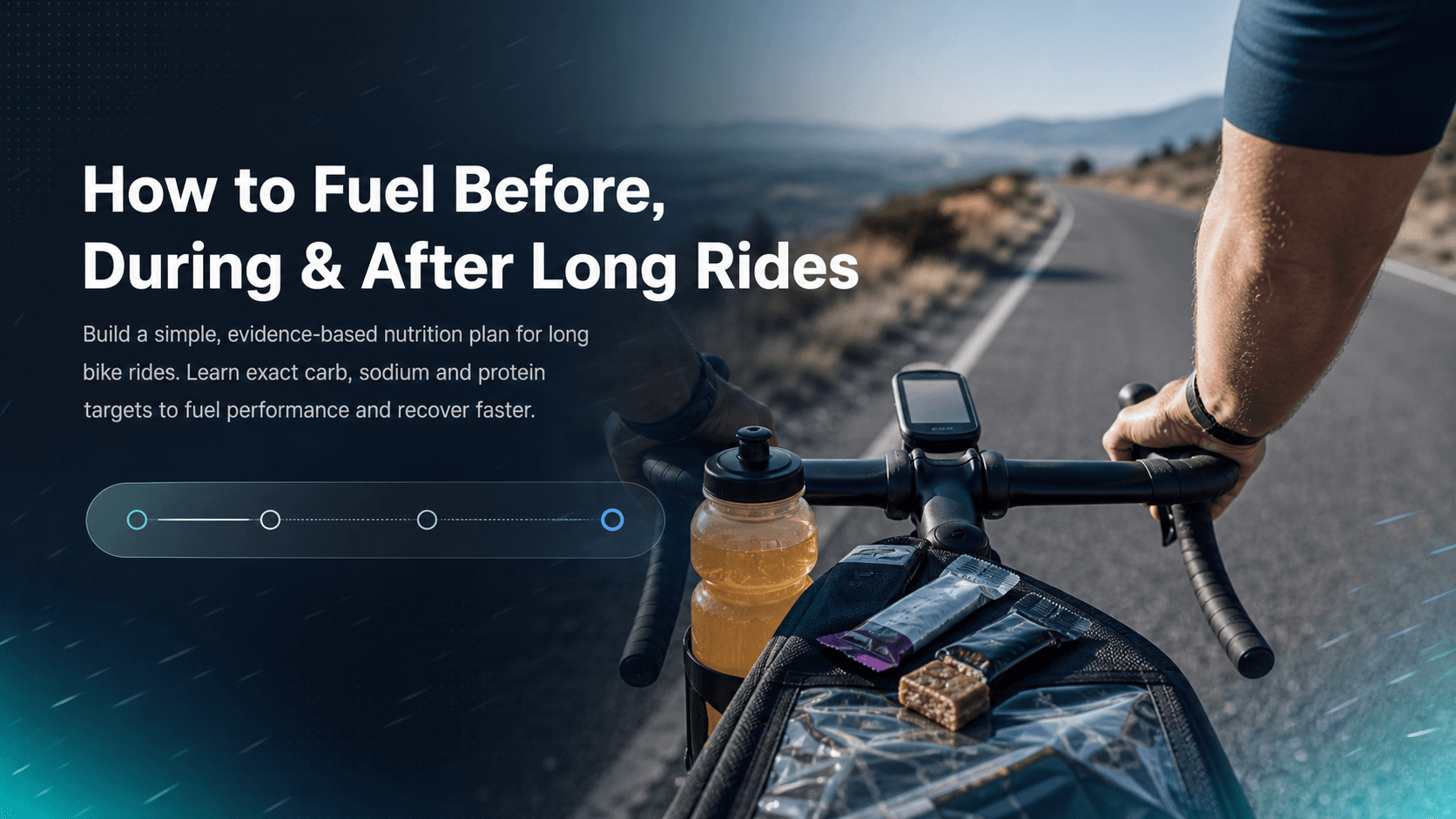
You've picked a great route. The legs feel good. The weather looks promising. And then, somewhere around the two-and-a-half-hour mark, the wheels come off, not mechanically, but metabolically. Power drops, your mood tanks, and you're grinding home on empty.
It's almost never a fitness problem. It's a fuelling problem.
This guide gives you a simple, repeatable nutrition plan for every long ride: what to eat before, what to take during, and how to recover properly after. Every recommendation here is anchored in evidence-based targets, not generic advice. You'll leave with actual numbers you can use on your next big Saturday.
Who this is for: road cyclists and sportive riders doing 2+ hours. What you'll need: your normal ride food and drink, a rough idea of your body weight (in kg), and about 10 minutes to fill in the template at the end. Difficulty: easy. Time to build your plan: 15 minutes.
The only rule you really need: carbs first, then everything else
Your muscles run on glycogen, a stored form of carbohydrate. On a long ride, you'll burn through it steadily, and once it's gone, power output falls sharply. Cyclists call this 'bonking' or 'hitting the wall'. It's not dramatic; it's just your body telling you the tank is dry.
The solution isn't to eat more at breakfast. It's to keep topping up carbohydrate throughout the ride at a rate that matches your output. Hydration and sodium matter too, they support gut absorption and fluid balance, but carbohydrate is the primary lever.
You're not guessing here. Use hourly targets and a simple schedule, and the bonk becomes entirely avoidable.
Before the ride (2–4 hours out): top up glycogen without upsetting your stomach
Research published in PMC's Carbohydrates and Endurance Exercise review recommends 1–4 g of carbohydrate per kilogram of body weight, consumed 1 to 4 hours before endurance exercise. In practice, most club cyclists find 2–3 hours before departure is the sweet spot: long enough for the meal to settle, close enough that glycogen stores are properly topped up.
What to eat:
- Porridge with banana and a drizzle of honey
- Toast or bagels with jam or peanut butter (go easy on the peanut butter if fat bothers your gut)
- Rice with a small amount of lean protein
- Pasta with a light sauce
Familiar carbs, moderate protein, low fibre and low fat if you're sensitive to GI issues on the bike. The last thing you want is to discover a new breakfast food causes stomach cramps at kilometre 40.
What to avoid before a long ride:
- New foods or untested gels/bars (save experiments for training, never race day or a long club ride)
- Very high-fibre meals (lentils, bran cereals, raw vegetables in volume)
- Greasy or fried food
- Large amounts of caffeine on an empty stomach if it unsettles you
Quick pre-ride checklist:
- Carb-based meal eaten 2–3 hours before departure
- Hydrated overnight (urine pale yellow by morning)
- Bottles filled and food in pockets before you leave
Before the ride (0–30 minutes): the steady start
If your pre-ride meal was small, or you're heading out for something long and hard, a small fast-carb hit 15–30 minutes before you clip in can help. This isn't a full snack, it's just a top-up.
Good options include a small banana, half an energy bar, a gel with water, or a few sips of a carbohydrate sports drink. Keep it simple and keep the portion small (20–30 g of carbs is plenty). Your digestive system doesn't need a full meal right before sustained effort.
One note: some cyclists wonder about mouth-rinsing carbs rather than swallowing. That technique has a place in very short, high-intensity sessions, but for long rides you need actual fuel in your system. Swallow the carbs.
During the ride: hit an hourly carb target
This is your main job while riding. The International Society of Sports Nutrition (ISSN) position stand recommends 30–60 grams of carbohydrate per hour for high-intensity exercise lasting longer than 60 minutes, consumed in a 6–8% carbohydrate solution every 10–15 minutes.
In plain terms: set an alarm or timer on your head unit, and eat or drink every 15–20 minutes from the start of the ride. Don't wait until you're hungry. By the time hunger arrives, you're already behind.
Practical implementation:
| Ride duration | Hourly carb target | Example combination |
|---|---|---|
| 60–90 min | 30–40 g/h | 1 energy gel + sips of sports drink |
| 90–180 min | 40–60 g/h | 1 gel + 1 bottle of 6% carb drink |
| 3+ hours | 60 g/h (or higher) | 2 gels + sports drink, or chews + drink |
For very long efforts (4+ hours), some well-trained riders tolerate 80–90 g/h using multiple transportable carbohydrates, a glucose and fructose blend. The ISSN notes this approach supports higher exogenous carbohydrate oxidation because the two sugars use different intestinal transport pathways, preventing the bottleneck that limits absorption from a single carb source. Products that list both glucose (or maltodextrin) and fructose on the label are specifically designed for this.
Gut training tip: the 60+ g/h range is achievable, but your gut needs to adapt. Use your exact race-day products, the same gels, same drink, same timing, during training rides first. GI distress on a long ride is almost always a sign of unfamiliar products or too much too fast, not a sign the approach doesn't work.
If you find solid food (bars, rice cakes, flapjacks) easier to manage mentally on long rides, use them in the first half when digestion is easier. Switch to gels and chews in the latter half when effort is higher and gut blood flow is reduced.
During the ride: hydration and sodium so you actually absorb the fuel
Carbohydrate absorption depends on fluid. Drink too little and your gut slows; drink too much at once and you feel bloated. The strategy is steady sipping: a few mouthfuls every 10–15 minutes rather than draining a bottle in one go.
For sodium, the American College of Sports Medicine (ACSM) recommends 300–600 mg of sodium per hour during prolonged exercise. Sodium helps retain fluid, maintains plasma volume and supports carbohydrate absorption in the gut. It's also highly individual: heavier sweaters, those riding in heat, and riders who notice white salt crust on their kit or skin need to sit at the upper end of that range.
Signs you need more sodium:
- Legs feel flat or heavy without obvious reason
- Muscle cramping in hot conditions
- White residue on skin or clothing after the ride
- Feeling dizzy or 'off' despite eating enough
Practical bottle setup:
If you carry two bottles: one with a carbohydrate-electrolyte drink (your fuelling bottle), one with water (to manage palatability and top up hydration between feed stops). If you only carry one bottle on shorter sections, use a carb-electrolyte mix and supplement with plain water at cafes or stops.
Most carbohydrate sports drinks contain some sodium, but check the label. If you're a heavy sweater or riding in summer heat, adding a separate electrolyte tab can get you to the higher end of the sodium range without loading your drink with excessive sweetness.
After the ride: recover fast so your next session actually happens
Post-ride nutrition has two targets: restore glycogen and repair muscle. Get both wrong and you'll feel it for days.
Carbohydrate (glycogen restoration): The Gatorade Sports Science Institute, synthesising research across multiple endurance studies, recommends 1.0–1.2 g of carbohydrate per kilogram of body weight per hour for the first 4 hours after exhaustive endurance exercise, using moderate to high glycaemic index carbohydrates. So a 70 kg rider should aim for 70–84 g of carbs in the first hour after a hard long ride, and repeat that through the recovery window.
For context: a large banana has around 27 g, a 500 ml glass of flavoured milk has roughly 25–30 g, and a jacket potato has 50+ g. Combinations get you there quickly.
Protein (muscle repair): Alongside carbs, a practical post-exercise protein target is around 0.3 g per kilogram of body weight, per dose (as discussed in endurance athlete nutrition literature published via PMC). For a 70 kg rider, that's roughly 21 g of protein in your recovery meal or snack. This is easily hit with a glass of milk, a pot of Greek yoghurt, or a chicken breast.
A carb:protein ratio of 3:1 or 4:1 is a widely used rule of thumb for recovery. It's not precise science, but it's a useful mental shortcut: for every 3–4 g of carbs you eat post-ride, aim for 1 g of protein.
Recovery meal ideas (plug and play)
Rotate through these depending on what you have at home:
- Flavoured milk + banana, fast-digesting carbs, natural protein from milk, easy on the gut immediately post-ride.
- Rice + grilled chicken or tofu, substantial carb base, solid protein, low in fat for faster gastric emptying.
- Bagel with cottage cheese or smoked salmon, carbs from the bagel, protein from dairy or fish, easy to prepare quickly.
- Pasta with lean mince or a pulse-based sauce, solid glycogen replenishment with moderate protein, great for an evening recovery after a long morning ride.
- Jacket potato + baked beans + yoghurt, high carb, plant-based protein combo, and the yoghurt adds a quick dairy protein hit.
- Smoothie (banana + oats + milk + protein powder), drinkable recovery when appetite is low, which is common after very hard efforts.
- Soup + crusty bread + Greek yoghurt, warm, easy to eat when you're cold and tired, covers carbs and protein across three components.
All of these work. The best one is whichever you'll actually eat within 30 minutes of getting off the bike.
Common mistakes (and quick fixes)
Under-fuelling in the first hour. You feel fine at the start, so you hold off eating. Then you bonk at hour two and wonder why. Fix: start fuelling by minute 20–30, before you need it.
Eating too many solids or high-fibre foods mid-ride. Flapjacks, dense bars and real food are fine early on, but later in hard efforts they can cause GI distress. Fix: shift to drinkable carbs or gels as intensity climbs or duration extends.
Skimping on sodium. Plain water with plain gels in hot conditions leaves you low on electrolytes. Fix: use a carb-electrolyte drink and/or add electrolyte tabs, especially in summer or after sweating heavily.
Missing the recovery window. Getting home, showering, scrolling your phone for 90 minutes, then eating. Fix: keep a recovery drink or snack in the fridge before you leave. Drink or eat it within 30 minutes of finishing.
Testing new products on a long ride. Always, always test new gels, bars or drinks on shorter training rides first. Your gut needs to meet them before they matter.
Your 1-page long-ride fuel plan
Just as Tailwind GPS gives you one clear score to answer 'should I ride this route today?', your nutrition plan should be just as glanceable. Fill this in once, test it on a training ride, and lock it in before your next big event.
My long-ride fuel plan
| Element | My target |
|---|---|
| Ride duration | ______ hours |
| Intensity (easy/moderate/hard) | ______ |
| Pre-ride meal (2–3 hrs before) | ______ g carbs, familiar foods |
| Pre-ride snack (0–30 min before) | ______ g carbs (optional) |
| Hourly carb target on the bike | ______ g/h (30–60 g baseline) |
| Carb source(s) | Gel / chews / drink / bar |
| Sodium target per hour | ______ mg/h (300–600 mg baseline) |
| Bottle 1 | Carb-electrolyte drink |
| Bottle 2 / stops | Water / top-up |
| Post-ride carbs (within 30 min) | ______ g (target: 1.0–1.2 g/kg) |
| Post-ride protein (within 30 min) | ______ g (target: ~0.3 g/kg) |
| Recovery meal within 2 hours | ______ (pick from ideas above) |
Test the plan on a mid-week training ride before you use it for a sportive, gran fondo or big club day out. Adjust the hourly carb target up if you bonked, down if you felt bloated, and tweak sodium if you cramped or felt flat.
Nutrition and route planning work best together. Once your fuelling plan is dialled in, make sure the ride itself is set up for success too. Tailwind GPS analyses the wind conditions along every kilometre of your route, hour by hour, so you know which direction to tackle first, when to leave, and where you'll get the best conditions. Because there's no point nailing your nutrition if the first 30 km are straight into a 25 km/h headwind when you could have reversed the loop.
For club rides specifically, route planning and sharing for Sunday groups covers how to coordinate the route decision alongside conditions, which pairs well with a shared nutrition strategy across the group.
Want to use wind to your advantage in training rather than just avoid it? The wind-aware hard and easy days guide walks through how deliberate headwind sessions build strength, and when to schedule them around your recovery needs.
Match nutrition to conditions
Headwind days burn more energy — check your route score before you pack your pockets.
Related posts
How to Build Endurance Without Overtraining
Learn how to build cycling endurance without overtraining using a practical load, recovery, and adjustment system. Includes Zone 2 tips, warning signs, and weekly templates.
·10 min read
How to Improve Your Climbing
Climb faster on your road bike with structured FTP, threshold, and VO2 max training, plus smarter pacing, cadence, and route-specific wind planning.
·10 min read
How to ride faster without getting fitter: a quick-wins checklist
Ride faster on the same fitness with proven aero, cadence, drafting, and pacing techniques. Includes a pre-ride safety checklist and a real-ride example.
·9 min read