
Which cycling route planner has the most generous free plan?
Most free cycling route planners are generous until you actually try to use them. You draw a route, go to export it, and hit a paywall. Or you want to check conditions for next Saturday, and the forecast is locked behind a subscription. Or you're planning a ride 30 miles from home and discover...
Most free cycling route planners are generous until you actually try to use them. You draw a route, go to export it, and hit a paywall. Or you want to check conditions for next Saturday, and the forecast is locked behind a subscription. Or you're planning a ride 30 miles from home and discover your "free" navigation only works in one region.
This comparison cuts through that. We measured free plans on four criteria: how many routes you can save, how far ahead the forecast reaches, whether that forecast is route-specific (not just a postcode), and how usable the export and sharing tools are without paying. Here's how the main contenders stack up.
Tailwind GPS: the most generous free plan for weather-aware route planning
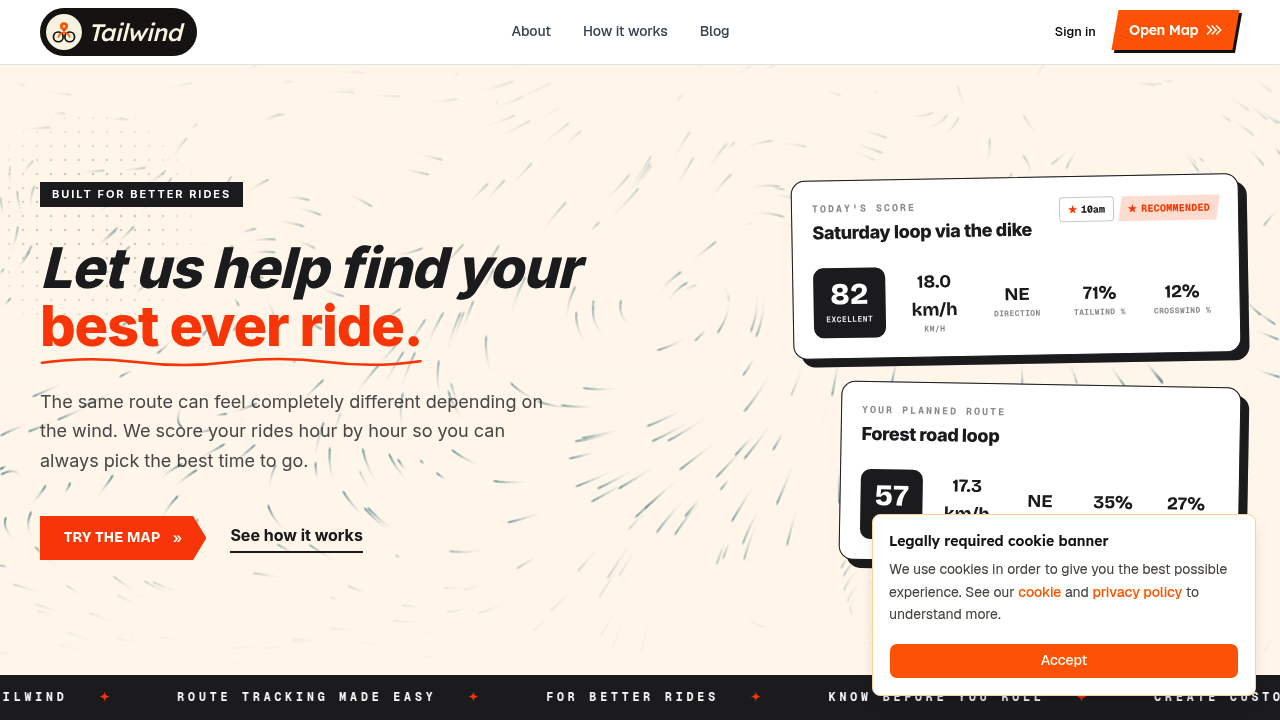
Free plan includes: up to 3 saved routes, 3-day forecast window, GPX import/export, Strava integration, route drawing, route sharing.
Tailwind GPS is built around one question: "Given the routes I already ride, when should I go?" The free tier answers that question properly. You get up to three saved routes (connect Strava and your regular routes import automatically, or upload a GPX), and for each route you get a Tailwind Score (0-100) for every departure hour across the next three days.
That score isn't a generic weather number. It's calculated by sampling wind direction and speed, temperature, and precipitation along every segment of your actual route, then weighting it against your riding pace. A score of 80-100 means predominantly favourable tailwinds. Below 40, expect a grim slog. The difference from a postcode forecast is significant: a westerly wind might be a tailwind on one loop and a headwind on another, and Tailwind GPS knows which.
GPX export is included on free, so you can push routes to a Garmin or Wahoo without upgrading. Route sharing works too. The whole thing runs in a browser with no app download required.
Where free ends: the 3-day forecast window means you can't plan for next weekend if it's more than 72 hours out. The paid plan (from $2.99/month or $19.99/year) lifts that to 14 days and expands saved routes to 40, plus adds a weekly best-rides email. There's a 7-day trial. For most club cyclists who ride the same three or four routes regularly, the free tier is genuinely sufficient for day-to-day decisions.
Komoot: strong planning tools, but free navigation is region-locked
Free plan includes: route planning and creation, one free region for offline navigation and core features, community route library.
Komoot covers route discovery and adventure planning, with polished routing tools and community-generated content. The catch is geographic: according to Komoot's own support documentation, every new account includes one free region to explore core features. Navigation and offline use beyond that region requires purchasing additional map regions or subscribing to Premium.
For cyclists who ride entirely within their home region, this may never be a practical limitation. But if your club run occasionally crosses into a neighbouring county or you're planning a sportive somewhere new, that single-region boundary matters. There's also no equivalent of a route-specific weather score on the free plan; you'd check a weather app separately and interpret conditions yourself.
Komoot wins for route discovery, community, and turn-by-turn navigation within your purchased regions. It's less suited to answering "which of my usual routes will feel best at 7am on Thursday?"
Strava: free for recording, limited for route planning
Free plan includes: activity recording and sharing, segment tracking, social feed, basic profile stats.
Strava's Help Centre states clearly: "Yes, Strava is a free app, and there is no cost to record and share your activities." That's accurate and generous if recording is your goal. Route building is a different matter. Advanced route creation tools and the ability to sync planned routes to devices sit behind the Strava subscription, which puts Strava in a different category for this comparison.
Strava's free tier is the best in the market for what it does: logging rides, tracking segments, and connecting with other riders. It's not designed to answer "where should I ride today based on the wind?" and it doesn't try to. If you already use Strava, the good news is that Tailwind GPS pulls in your Strava routes automatically, so you can get route-specific weather scores on the routes you've already built there.
Ride with GPS: capable route planner, weather scoring not included on free
Free plan includes: basic route creation and editing, GPX export, route library.
Ride with GPS positions itself squarely as a route planning and navigation platform, and the core planning tools work well on the free tier. You can draw routes, export GPX files, and save routes to your library. Navigation features and more advanced tools are available on paid plans.
What free doesn't include is any kind of route-specific weather or wind forecast. That's not a criticism, Ride with GPS isn't trying to be a weather-aware planner. But it means the comparison ends there for cyclists whose main question is about conditions, not just cartography. For pure mapping and exporting workflows, it's a solid option.
Plotaroute: free plotting tools, with export and collection limits
Free plan includes: route plotting, public route sharing, basic GPX/TCX/KML export within usage limits.
Plotatoute's Standard membership is free and covers the fundamentals of drawing and sharing routes. It's a capable planner with a clear focus on mapping tools. The limitations that surface on the free tier relate to download volumes (GPX, TCX, KML exports are subject to usage limits on the free tier per Plotaroute's membership page) and bulk collections. If you're building a large route library or need to batch-export files regularly, those caps will become relevant.
Like Ride with GPS, Plotaroute is a mapping tool rather than a forecasting tool. There's no route-specific weather scoring, and no way to compare how two routes will feel at 8am on Saturday. For route drawing alone, it does the job. For deciding when and which route to ride based on conditions, it's not in scope.
Who should use which planner?
For cyclists who want to know when conditions will suit their usual loops: Tailwind GPS free is the strongest option. Three saved routes, a 3-day forecast, route-specific scoring per departure hour, GPX in and out. The interactive wind map alone is worth the sign-up.
For route discovery and community content: Komoot is a reasonable option, particularly once you've purchased your home region maps — though for weather-scored timing on your usual routes, Tailwind GPS free is the stronger pick.
For tracking and social features: Strava free is the default choice for most club cyclists. Pair it with Tailwind GPS for the weather-scored planning layer.
For pure route mapping and export without weather: Ride with GPS or Plotaroute cover the basics well, with Ride with GPS having an edge in navigation workflow and Plotaroute in raw plotting flexibility.
The best route planners compared for 2026 goes deeper on features beyond weather if you want a wider view.
FAQ: free plan questions
Is the Tailwind GPS free plan actually free, or does it expire? It's free forever. No trial period. You get up to 3 saved routes and forecasts 3 days ahead without paying anything.
Can I use my Strava routes with Tailwind GPS without paying? Yes. Connect your Strava account and your routes import automatically. The free plan gives you weather scores on up to 3 of them.
Do I need to download an app? No. Tailwind GPS runs in your browser and can be added to your home screen. No App Store or Play Store required.
How does the Tailwind Score work? Each route gets a score from 0 to 100 for every departure hour. The score reflects wind direction relative to your route heading, wind speed, temperature, and rain probability, all sampled along the actual route and weighted by your pace. 80-100 is excellent. Below 40 is tough. See the weather-scored cycling apps comparison for how this compares to alternatives.
What does upgrading actually unlock? The paid plan (from $2.99/month) extends the forecast window from 3 days to 14 days and increases saved routes from 3 to 60. Subscribers also get a weekly best-rides email. There's a 7-day free trial.
Do other planners let you save more routes for free? Some allow unlimited route storage (Ride with GPS and Plotaroute both permit saving routes on their free tiers), but neither provides route-specific weather scoring. The number of saved routes is only half the picture; the forecast value attached to each route is what makes the difference for ride timing decisions. If you're planning harder and easier training days around the forecast, the weather-scored hard and easy days workflow explains exactly how to do that.
Compare plans yourself and start free at tailwindgps.com.

Free forever on 3 routes
Enjoyed that? Put it to work on your next ride.
- Every route scored for wind, rain and temperature
- The best hour to ride, up to 3 days out
- Strava routes in with one tap
Free forever on 3 routes. No card.
Related guides
Best Free Cycling Navigation App in 2026
Compare Komoot, Strava, Ride with GPS and Tailwind GPS for free cycling navigation, including voice prompts, rerouting and a wind score.
·5 min read
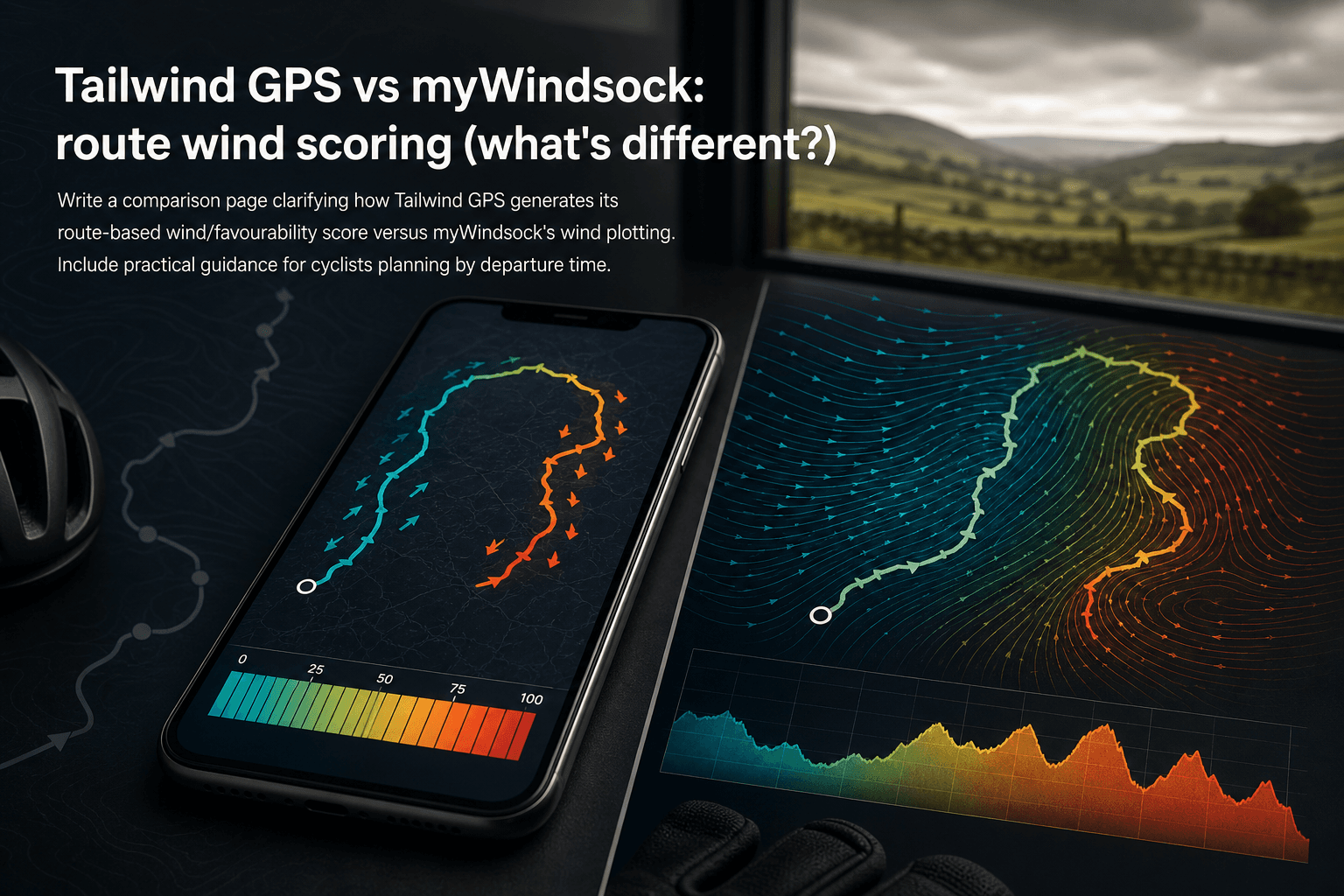
Tailwind GPS vs myWindsock: route scoring (what's different?)
How Tailwind GPS's 0–100 route weather score differs from myWindsock's Air Penalty scoring — and which to use for departure timing vs performance analysis.
·10 min read

Strava route planner vs weather-scored planning
Strava is genuinely excellent at route planning. The heatmap alone has probably sent millions of cyclists down roads they'd never have found otherwise. But if you've ever glanced at the forecast before a Saturday club run, set off into a gentle-looking 15 km/h wind, and spent the final 30 km g...
·8 min read