How to Train for Your First 100 km Ride
A complete 8–12 week 100km bike ride training plan with pacing targets, fuelling schedules, and route-timing tips to make every long ride count.
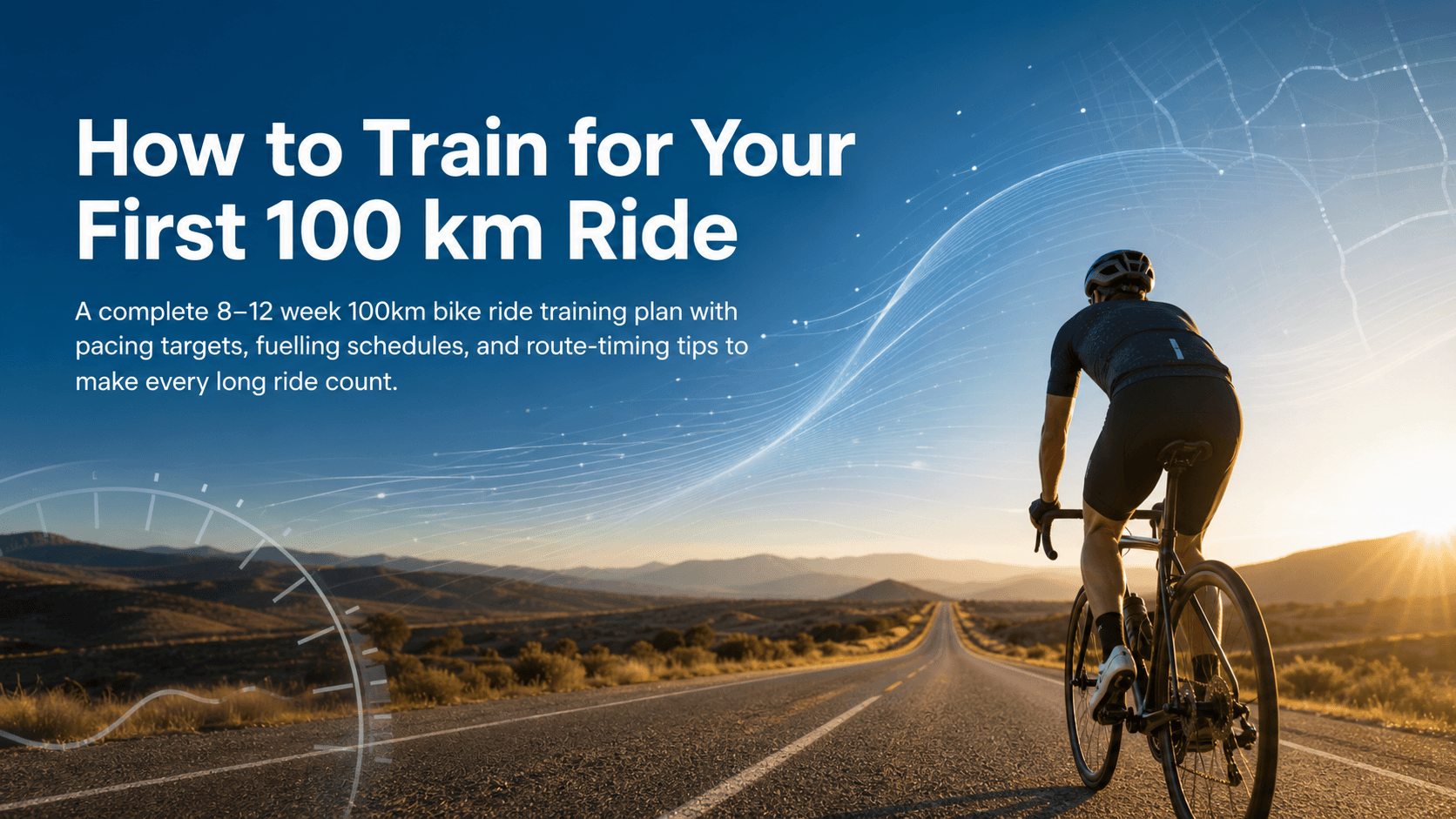
So you've decided to do your first 100 km. Good. It's one of those rides that genuinely changes how you see yourself as a cyclist. But if your longest ride is currently 40 km and the event is in three months, you're probably wondering whether you can actually bridge that gap without wrecking yourself in the process.
You can. You just need a plan that's honest about the process.
This guide gives you everything: a structured week-by-week progression, measurable intensity targets, a fuelling schedule that prevents the dreaded bonk, a kit checklist, and a pacing strategy you can actually remember on the day. It's built for cyclists who ride with purpose and want something more specific than "just ride more."
Quick reality check: how long you need (and whether you're ready)
Most beginners need 8 to 12 weeks to prepare for their first 100 km ride. Cycling UK recommends starting your programme at least 10 weeks out. TrainerRoad suggests a minimum of 12 weeks for thorough base training. Where you land in that range depends almost entirely on your starting point.
Here's a simple readiness check:
- You can probably use the 8-week plan if your current longest ride is 40–50 km and you're riding 3 or more times per week.
- You're better off with the 12-week plan if your longest recent ride is under 30 km or you've been off the bike for a while.
- You need a few more weeks of base first if you can't comfortably ride 25 km without stopping.
If you have any underlying health concerns, check with a clinician before beginning a structured endurance programme.
Your training structure: simple, repeatable, measurable
Three rides per week is the minimum. Four is better. The roles of those rides matter more than the total volume.
| Ride type | Frequency | Purpose |
|---|---|---|
| Long ride | Once per week | Build endurance base |
| Quality session | Once per week | Tempo, sweet spot, or intervals |
| Easy/recovery ride | Once or twice per week | Flush fatigue, stay consistent |
The long ride is the backbone of your 100km bike ride training plan. Everything else supports it.
On progressive overload: increase your long ride distance by no more than 10–15% each week. Every third or fourth week, cut the long ride by 30–40% to let your body consolidate the adaptation. This isn't optional, skipping the recovery week is how people get injured or burned out six weeks in.
Set your targets: HR, power, and RPE
This is where most training guides fall short. Without measurable targets, riders accidentally race their endurance sessions and arrive at the event already tired.
Your long rides must stay in Zone 2, genuinely aerobic, conversational pace. If you can't complete a full sentence, you're going too hard.
| Metric | Zone 2 target |
|---|---|
| Power (FTP-based) | 56–75% of FTP |
| Heart rate | 60–70% of max HR |
| RPE (1–10 scale) | 3–4 out of 10 |
| Talk test | Full sentences, mild effort |
For those without a power meter or HR monitor: the talk test is genuinely reliable. Ride with a friend, or narrate your surroundings aloud. If you're struggling to speak in full sentences, slow down.
The classic mistake is riding the first 30 km of a long session as if it's a race. You feel good, the legs are fresh, and you push. By kilometre 70 on the day you're crawling. Discipline early is what makes the finish feel strong.
If you do train with power, RPE pacing for long rides pairs well with an easy and hard day planning workflow, where wind-aware scheduling lets you choose which days to push and which to protect.
8-week progressive plan
This is your starter template. Copy it, adapt it, make it yours.
| Week | Long ride | Midweek quality | Midweek easy | Notes |
|---|---|---|---|---|
| 1 | 40 km | 45 min Zone 2 steady | 30 min easy spin | Establish rhythm |
| 2 | 48 km | 50 min with 2x10 min tempo | 30 min easy | First taste of quality work |
| 3 | 55 km | 55 min with 3x8 min sweet spot | 35 min easy | Longest yet |
| 4 | 38 km (recovery) | 40 min easy Zone 2 | Rest | Recovery week |
| 5 | 62 km | 60 min with 3x10 min sweet spot | 35 min easy | Over halfway |
| 6 | 70 km | 60 min with 4x8 min tempo | 40 min easy | Building confidence |
| 7 | 80–85 km | 45 min easy | Rest | Peak week, protect it |
| 8 | Event week: taper | 30 min easy legs | Rest | Trust the training |
For the quality session each week: warm up for 10–15 minutes in Zone 1/2, hit your intervals, cool down for 10 minutes. Keep the easy rides genuinely easy, Zone 1 is not wasted time.
Sleep is training. Aim for 7–9 hours during this block. It's where adaptation actually happens.
12-week plan: if you're starting from shorter rides
If your base is under 30 km, a slower progression is safer and more effective in the long run. The 12-week plan uses the same structure but with smaller weekly jumps and a longer taper.
| Week | Long ride | Key change |
|---|---|---|
| 1–2 | 25–30 km | Base building, all Zone 2 |
| 3–4 | 35–40 km | Introduce one tempo session |
| 5–6 | 45–52 km | Increase consistency |
| 7 | 38 km (recovery) | Planned down week |
| 8–9 | 60–68 km | Quality sessions increase |
| 10 | 75–80 km | Peak long ride |
| 11 | 55 km (taper begins) | Reduce volume, maintain intensity |
| 12 | Event week: 20–30 km easy | Arrive fresh |
The key difference from the 8-week version: you spend more time in Zone 2 before introducing hard efforts, and your peak long ride comes two weeks before the event rather than one. This suits riders who need more time to build aerobic capacity before stressing the system with intensity.
How to pace your 100 km on the day
A century ride pacing strategy you can actually remember: thirds.
- First 35 km: easier than feels necessary. Your perceived effort should be 3/10. If you're in a group, sit in the wheels and resist the urge to pull through.
- Middle 35 km: settle into your Zone 2. This is your working pace. Maintain it consistently.
- Final 30 km: if you still have energy, you can increase effort slightly. If you've paced correctly, this section actually feels manageable.
Riding in a group? The biggest trap is getting dragged too fast by stronger riders in the first hour. Accept their pace only if you can recover fully between efforts. If you're constantly at the front and your heart rate is 80% of max before kilometre 20, you've already lost the game.
What if you miss the pacing target early? Don't panic. Ease off, eat something, and lower your effort for 10–15 minutes. Most riders can recover from a pace overshoot in the first half. Nobody recovers from one at kilometre 60.
Fuel and hydrate: the detail that stops the bonk
This is non-negotiable. Bonking (running out of glycogen mid-ride) isn't a character flaw, it's a fuelling failure, and it's entirely preventable.
How many carbs per hour?
British Cycling's event-day guidance recommends roughly 1 gram of carbohydrate per kilogram of bodyweight per hour. For a 75 kg rider, that's approximately 75 g/hour. For reference, that sits within the 60–90 g/hour range that TrainerRoad cites for longer cycling efforts. ACSM-backed guidance referenced in PMC research puts the general endurance range at 30–60 g/hour, which is appropriate for lower intensities or early in the ride.
A practical rule: aim for 60 g/hour as your target, scaling up towards 75–90 g/hour if the pace is high or the day is hot.
On-bike fuelling schedule
| Time | Action |
|---|---|
| 0:00 | Start riding, don't eat yet unless you didn't have a pre-ride meal |
| 0:20 | First gel, bar, or banana (start fuelling before hunger hits) |
| 0:40–1:00 | Second carb source + first sip electrolyte drink |
| Every 20–30 min after | Alternate between solid food and gels; drink every 15–20 min |
| 2:00+ | Increase carb intake if effort rises |
For hydration: ROUVY's guidance (June 2026) states most riders need 500–750 ml per hour in normal conditions, rising to 750–1,000 ml per hour in heat or when training indoors. If you're unsure of your sweat rate, weigh yourself before and after a 60-minute ride. Every kilogram lost is approximately one litre of fluid deficit.
Electrolytes matter on efforts over 90 minutes. Include sodium either through electrolyte tabs, sports drinks, or salty snacks to prevent cramping and retain fluid.
Train your gut
Never try a new product on the event day. Every gel, bar, and drink you plan to use on the 100 km should be tested repeatedly in training. Some riders tolerate gels well; others need real food. Your gut is trainable, but only if you practice. Run your exact fuelling plan on your longest training rides.
Kit and bike setup for comfort over 100 km
Comfort becomes a performance variable once you're past 60 km. Here's what actually matters.
Bike fit is the foundation. Your saddle height, reach, and bar position should be dialled before you start long rides. A position that feels fine at 30 km can become genuinely painful at 80 km. If in doubt, a professional fit is worth it.
Bib shorts with a quality chamois are not optional for this distance. Add chamois cream to friction-prone areas, particularly on long training rides. You won't regret it.
What to pack for a 100 km ride:
- 2 inner tubes, tyre levers, and a pump or CO2 inflator
- Multi-tool with chain breaker
- Phone (charged, downloaded maps)
- Emergency cash or card
- 2 water bottles minimum (or a frame bag for extra capacity)
- All your pre-planned food
- Gilet or rain jacket (one layer is enough)
- Sunscreen, especially for rides over 2 hours
Final week bike check:
- Tyre pressure and tread condition
- Drivetrain cleaned and lubed
- Brake cables and lever feel
- Quick-release or thru-axle tightness
- Helmet straps adjusted correctly
Recovery: the session that makes the next one possible
After crossing the finish line of your 100 km, your job isn't over.
Within 30–45 minutes of finishing, take on carbohydrates and protein. A ratio of roughly 3:1 carbs to protein works well. A large bowl of rice and chicken, or a recovery shake with a banana, both do the job.
The next day: a 20–30 minute easy spin at Zone 1 (not rest, not intensity) is better for recovery than full rest for most riders. It keeps blood moving through sore muscles without adding stress.
Expect 48–72 hours of muscle soreness after your first 100 km, especially in the glutes and quads. This is normal. If soreness persists beyond 96 hours or you feel genuinely ill, take an extra day or two. There's no prize for rushing back.
Sleep is the best recovery tool you have. Prioritise 8–9 hours in the days immediately after the event.
How Tailwind GPS helps you execute the plan
Here's something most training guides completely ignore: the conditions on the day of your long ride have a direct impact on whether you actually complete it successfully.
A 75 km training ride into a sustained headwind burns significantly more energy and takes longer than the same ride with neutral or favourable conditions. Doing that repeatedly across an 8-week block isn't good training, it's accidental overtraining. Rain-cancelled long rides break the progressive overload chain entirely.
Tailwind GPS analyses wind, temperature, and rain probability along your entire route, not just at your postcode, and assigns each departure hour a Tailwind Score from 0 to 100:
- 80–100: excellent conditions
- 55–79: great riding
- 40–54: neutral
- 20–39: challenging
- 0–19: prepare for a tough one
The score is personalised to your average riding speed, so it reflects where you'll actually be on the route at any given hour. Connect your Strava routes and they appear automatically, or draw your own using the interactive route planner map.
For your weekend long rides, the practical habit is this: check the Tailwind Score for Saturday vs Sunday across your target loop and choose the better window. Subscribers get a 14-day route forecast, so you can spot your best training windows a fortnight ahead and protect them in your diary.
You can also set alerts so Tailwind GPS notifies you when a specific route hits your target score. Set it at 60+, and you'll get a nudge when the conditions align. No more checking five weather apps on Friday night trying to decide whether to bother.
If you're curious how this compares with other weather-focused cycling tools, the wind-aware cycling apps comparison for 2026 covers the main options honestly.
For club riders coordinating group long rides, the club ride route planning guide shows how to share time-specific route scores with the whole group so everyone starts on the same page.
FAQ and troubleshooting
What if I can't do the long ride on the weekend? Move it to whatever day works. The long ride is the non-negotiable session. Cut the quality session that week if you need to, not the long ride.
What if my nutrition plan fails mid-ride? Eat whatever is available (feed stations, cafes, bananas from a helpful spectator). Prioritise simple carbohydrates, slow down your pace by 10–15%, and keep drinking. This is exactly why you practice your fuelling in training, so you know what your body handles.
What if it's hilly, windy, or hot? Hills: your pace will naturally slow. Honour your RPE or HR target, not your speed. It's fine to walk a brutal climb on a training ride. On the event, staying in Zone 2 on climbs beats blowing up trying to maintain speed.
Wind: check your route-specific wind forecast and plan your departure accordingly. If unavoidable, add extra carbs and fluid for a headwind day.
Heat: increase fluid intake to 750–1,000 ml/hour and consider adding electrolytes to every bottle.
Can I train indoors? Yes, with a caveat. Turbo sessions count for quality work and short Zone 2 sessions. But long rides on a trainer beyond 90 minutes lose some of the positional and pacing specificity of the road. If you're using a smart trainer, aim to replicate outdoor pacing and cadence. For your longest sessions, try to get outside at least occasionally.
How do I taper without losing fitness? You won't lose fitness in one week. Cut volume by 40–50% in the final week, keep one short quality session (20 min at tempo), and keep the easy spins in. Resist the urge to squeeze in an extra long ride three days before the event. The fitness is already there. Arriving rested is what lets you use it.
Ready to plan your first long ride?
Your training is only as good as the sessions you actually complete. Check your next long ride on Tailwind GPS before you commit to a departure time. Connect your Strava routes, compare Saturday vs Sunday's Tailwind Score, and set an alert for when your loop hits the conditions it deserves.
You've done the planning. Now go find the right window to do the work.
Pick the best day to ride
Compare Saturday vs Sunday Tailwind Scores on your long-loop route before you commit.
Related posts
How to Build Endurance Without Overtraining
Learn how to build cycling endurance without overtraining using a practical load, recovery, and adjustment system. Includes Zone 2 tips, warning signs, and weekly templates.
·10 min read
How to Improve Your Climbing
Climb faster on your road bike with structured FTP, threshold, and VO2 max training, plus smarter pacing, cadence, and route-specific wind planning.
·10 min read
How to ride faster without getting fitter: a quick-wins checklist
Ride faster on the same fitness with proven aero, cadence, drafting, and pacing techniques. Includes a pre-ride safety checklist and a real-ride example.
·9 min read