Tailwind GPS vs Epic Ride Weather vs myWindsock
Three apps. All promising to tell you how wind will affect your ride. But they solve very different problems, and choosing the wrong one wastes time, money, and possibly a Saturday morning into a 30 mph headwind.

Three apps. All promising to tell you how wind will affect your ride. But they solve very different problems, and choosing the wrong one wastes time, money, and possibly a Saturday morning into a 30 mph headwind.
This comparison is for club and competitive cyclists who want a clear answer before committing to a subscription.
Quick answer: pick your best match in 30 seconds
| App | Best for |
|---|---|
| Tailwind GPS | Planning which route to ride and when to leave, up to 14 days ahead |
| Epic Ride Weather | Detailed minute-by-minute forecast feel on the day of your ride |
| myWindsock | Predicting how wind will affect your watts, segment times, and race strategy |
Choose Tailwind GPS if you...
- Captain a club run and need to pick the best loop for Sunday
- Want one score per departure hour without interpreting wind charts
- Plan rides a week or two out (sportives, training blocks, holidays)
- Use Strava and want your existing routes scored automatically
- Want alerts when a favourite route hits good conditions
Choose Epic Ride Weather if you...
- Already know you're riding today and want a granular forecast along the route
- Want to decide whether to flip the route direction at the last minute
- Prefer a mobile app experience with Strava, Garmin, and Komoot connectivity
Choose myWindsock if you...
- Race time trials or crits and want to know how wind affects your wattage and predicted finish time
- Are comfortable with performance-modelling concepts like CdA and air density
- Want to run race-day scenario planning at a technical level
What each app is actually trying to optimise
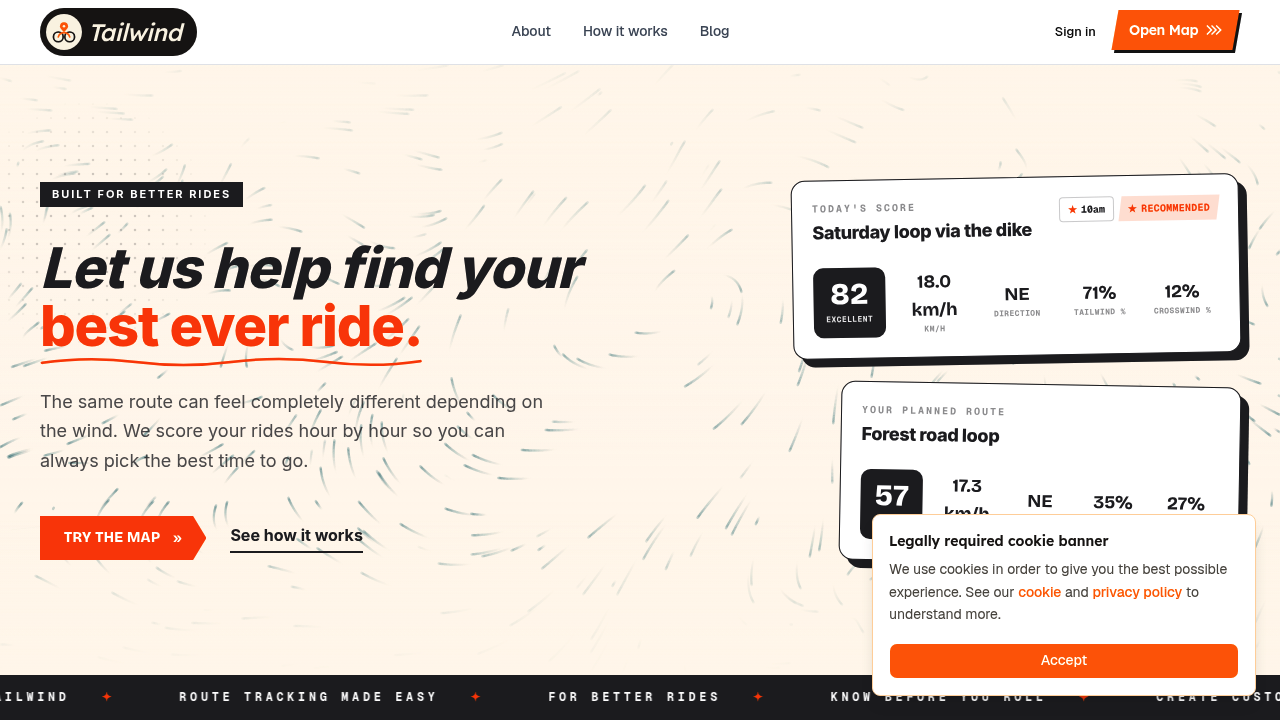
Tailwind GPS answers one question: given the routes you already ride, when should you go? The app analyses weather along the entire route, not just a pin on a map, sampling wind conditions hour by hour across every segment. Each route gets a Tailwind Score per departure hour, a 0–100 number that factors in wind direction relative to your heading, wind speed, temperature, and rain probability. Subscribers get up to 14 days of forecasts across up to 40 saved routes.
Epic Ride Weather focuses on the ride you're doing right now (or later today). It overlays a hyperlocal forecast on your planned route, accounting for wind speed, yaw angle, direction, departure time, and your average speed. The emphasis is on what you'll encounter along the way, and whether flipping the route to run with the wind rather than against it makes sense.
myWindsock is a web-based cycling intelligence tool that goes further into performance territory. Rather than just showing you the wind, it predicts how conditions translate into watts required and segment times. Micro-weather data (wind, rain, temperature, and air density) is layered with aerodynamic modelling, useful for riders preparing for a TT or targeting a segment PR.
Tailwind Score vs forecast view: how you interpret the weather
The biggest practical difference between the three is what you actually see when you open them.
With Tailwind GPS, you get a single number per hour. A score of 85 means excellent conditions, expect favourable tailwinds for most of the ride. Scores in the 55–79 range signal great riding. Between 40–54 it's neutral; 20–39 is challenging; 0–19 means prepare for a tough one. You don't need to understand prevailing pressure systems. You glance, compare a few departure times, and decide.
Epic Ride Weather presents a dynamic forecast strip along the route timeline. You see what's coming, a headwind section around kilometre 30, rain probability rising after midday, temperature dropping on the return leg. It's richer in moment-by-moment texture, but it asks you to interpret more.
myWindsock translates those same conditions into performance outcomes. Instead of "this section will be a headwind", you get something closer to "this section will cost you an extra 15 watts and add 45 seconds to your segment time." That specificity is genuinely valuable for racers. For everyone else, it can feel like a lot of information to process before a club spin.
Route planning and workflow: Strava, Garmin, GPX, and route building
All three support Strava and GPX files in some form. The differences are in how smoothly the workflows run and what you can do with routes once they're in.
With Tailwind GPS, connecting your Strava account pulls in your existing routes automatically. From there you can draw entirely new routes directly on the interactive route planner map, either snapping to roads or drawing freehand, then export as GPX for your Garmin, Wahoo, or Hammerhead Karoo. Shareable route links mean you can send conditions to club-mates without them needing an account.
Epic Ride Weather also connects Strava, Garmin, and Komoot, and accepts GPX, FIT, and TCX file uploads. It's well integrated for riders who route-plan elsewhere and want the forecast layered on top. The mobile app focus suits this: you plan the ride in Komoot, generate the forecast in Epic Ride Weather, go.
myWindsock handles route uploads through its web platform. It accepts Strava and file uploads, and the planner workflow is centred around building a specific race or ride scenario to model. Premium features (CdA input, virtual athlete profiles) unlock more of the forecast's value, though the exact tier pricing isn't displayed with the same transparency as Tailwind GPS.
Departure timing and the planning horizon
This is where Tailwind GPS makes the clearest case for itself.
Free users get a 3-day forecast window across up to 3 saved routes. Subscribers unlock 14-day forecasts and up to 40 routes at $2.99/month or $19.99/year. That 14-day horizon matters for sportive organisers, coaches planning training blocks, and anyone trying to book a cycling holiday around good conditions. You can also set up per-route email alerts that fire when a favourite loop hits a score you've chosen, so you're not checking the app daily.
Epic Ride Weather's free download includes a 30-day trial with 1,000 free forecasts, after which a subscription costs $2.99/month or $19.99/year. Its strength is ride-day detail, not advance planning across a calendar. If your question is "what will the wind do during this exact ride?", it can help. If the question is "which of the next 12 days looks best for a long ride?", Tailwind GPS is the better fit.
myWindsock is oriented around race-day scenario planning rather than a weekly calendar view. Its free tier is reportedly feature-rich, with Premium unlocking the more advanced race planning tools, aero modelling, and additional profile support. For a TT rider building their pre-race strategy, that Premium toolset is the whole point. For a club rider deciding when to head out on Thursday, it's overkill.
Wind and rain: what they show and how granular it feels
All three go beyond a generic forecast, but the presentation differs.
Tailwind GPS samples conditions along the whole route, hour by hour, accounting for each segment's direction and your expected position at that point in the ride. The output shows headwind, tailwind, and crosswind percentages, average wind speed, rain probability, and temperature, all weighted by distance and personalised to your riding pace. You're not seeing a town-centre forecast; you're seeing conditions at the specific point on the route where you'll be at that time.
Epic Ride Weather's minute-by-minute overlay gives a similarly route-shaped view, factoring in wind yaw angle (the effective angle of wind relative to your direction of travel) alongside speed and direction. That yaw angle consideration is a nice detail for aerodynamically minded riders. The visual format makes it easy to spot rough patches along the ride before you leave.
myWindsock visualises wind impact as a "windsock line" along the course, layering in wind speed, direction, rain, temperature, and air density. The performance modelling overlay is what separates it: those environmental inputs get converted into power predictions, which is where the wind-aware cycling training concept meets race-specific execution.
Training and competition use-cases
For a club run captain, the Saturday morning scenario is familiar: you've got three route options, a mixed forecast, and a WhatsApp thread of riders waiting for a decision. Tailwind GPS is built for this. Planning club rides with route-specific wind scores lets you compare routes side by side, spot that the shorter flatter loop has a score of 78 at 8am versus 44 at 10am, and send a single link so everyone sees the conditions.
For structured training, Tailwind GPS includes a Headwind Training mode, which deliberately surfaces routes and departure times with sustained headwinds. Useful when you want a hard effort without travelling to a specific climb, or when you want to schedule a difficult session while keeping easier recovery rides for days with better conditions.
For TT riders and crit racers, myWindsock's performance modelling is the more relevant tool. Knowing that a particular start time saves you 90 seconds on a 25-mile course because of reduced average head wind is actionable in a way that a general score isn't. Epic Ride Weather gives tactical awareness along the route (knowing where conditions deteriorate lets you manage pacing), which has real value for longer road races and gran fondos too.
Pricing and value
| Free tier | Paid subscription | |
|---|---|---|
| Tailwind GPS | 3 routes, 3-day forecast | $2.99/month or $19.99/year (40 routes, 14-day forecast, alerts) |
| Epic Ride Weather | 30-day trial, 1,000 forecasts | $2.99/month or $19.99/year |
| myWindsock | Free tier (feature-rich) | Premium tiers unlocking aero modelling and race planning (pricing varies by tier) |
Tailwind GPS and Epic Ride Weather sit at identical price points once you're subscribing. The difference is what you get: Tailwind GPS offers the longer planning window and alert system; Epic Ride Weather offers deeper ride-day granularity.
myWindsock's pricing structure is less transparent at first glance. The free tier covers a lot, but serious race optimisation requires Premium, and the tiered structure (Lite, Power, Unlimited) unlocks progressively more of the aero and power modelling. Worth investigating if performance modelling is your primary need; overkill if it isn't.
For most club and competitive cyclists, Tailwind GPS represents the clearest value: a generous free tier to try it properly, and a subscription that costs less than a single café stop per month.
Limitations and fit: who should not pick each one
Tailwind GPS is the right choice for most riders planning routes and timing departures. It's not the tool for you if your primary need is predicting how many extra watts a crosswind will cost you on the back leg of a TT. The score tells you conditions are challenging, it doesn't model your aerodynamic profile.
Epic Ride Weather is less suited to forward planning across multiple days. If you want to look two weeks ahead across your five regular loops and get an alert when conditions align, the ride-day-focused workflow doesn't naturally support that use-case.
myWindsock is the most powerful option in a narrow performance category, but the complexity is real. Riders who want to open an app, glance at a score, and make a decision in 30 seconds will find the interface frustrating rather than useful. It rewards cyclists who are willing to invest time in configuration and interpretation.
Verdict by rider type
| Rider type | Recommended app | Why |
|---|---|---|
| Club run captain | Tailwind GPS | Compare routes, score departure times, share conditions with the group |
| Sportive weekend planner | Tailwind GPS | 14-day horizon means you can spot the best day weeks out |
| Gravel endurance rider | Tailwind GPS | Long-route scoring and alerts for multi-day planning |
| Road racer (route tactics) | Epic Ride Weather | Granular forecast helps pace and tactic decisions mid-ride |
| Time triallist / crit racer | myWindsock | Wattage and segment time predictions justify the complexity |
| Structured trainer | Tailwind GPS | Headwind Training mode + easy/hard day planning built in |
For the majority of riders reading this, Tailwind GPS is the answer. It handles the planning question that actually eats up mental energy (which route, what time, is it worth going?) better than either alternative, at a price that's easy to justify. The best cycling apps for forecast-based planning piece covers a wider field if you want context beyond these three.
Score your routes free, start with Tailwind GPS
FAQ
How accurate are these forecasts?
No tool guarantees 100% accuracy. All three depend on underlying numerical weather prediction models, which become less reliable beyond 5–7 days regardless of how the app presents the data. For planning purposes, treat scores beyond a week as directional guidance rather than firm predictions. Closer to the ride, all three become meaningfully more reliable.
Which file formats do they support?
Tailwind GPS supports GPX import and export. Epic Ride Weather accepts GPX, FIT, and TCX files alongside Strava, Garmin, and Komoot integrations. myWindsock accepts route uploads via its web platform, including Strava-connected routes. If you're planning on a device like a Hammerhead Karoo or Garmin Edge, exporting a GPX from Tailwind GPS and loading it onto your head unit takes a few seconds.
What does connecting Strava actually involve?
Connecting Strava typically grants read access to your routes and activities. None of these apps need to write to your Strava profile to function. For Tailwind GPS specifically, Strava connection pulls your saved routes automatically, so you're not rebuilding loops from scratch. You can review the Tailwind GPS privacy policy for the full detail on what data is accessed and how it's handled.
What's the forecast horizon on the free plans?
Tailwind GPS free: 3-day forecast, up to 3 saved routes. Tailwind GPS subscriber ($2.99/month or $19.99/year): 14-day forecast, up to 40 routes. Epic Ride Weather: 30-day trial with 1,000 free forecasts, then a subscription at the same price point. myWindsock: a free tier with core features, with Premium unlocking advanced aero and race planning tools.
Can I get alerts when conditions are good?
Tailwind GPS subscribers can set per-route score thresholds and receive email alerts when a favourite route hits those conditions. Weekly ride summary emails are also included, surfacing the best upcoming windows without you needing to check daily. Epic Ride Weather and myWindsock do not offer the same proactive alerting workflow as a core feature of their standard plans.
For the wind scores across your Strava routes and everything else covered here, Tailwind GPS remains the most complete starting point for club and competitive cyclists who want better rides without spending more time interpreting forecasts.
Try it now
Open the interactive wind map and find your best ride window — no sign-up required.
Related posts
Tailwind GPS vs myWindsock: route wind scoring (what's different?)
How Tailwind GPS's 0–100 route wind score differs from myWindsock's Air Penalty scoring — and which to use for departure timing vs performance analysis.
·10 min read

Strava route planner vs wind-aware planning
Strava is genuinely excellent at route planning. The heatmap alone has probably sent millions of cyclists down roads they'd never have found otherwise. But if you've ever glanced at the forecast before a Saturday club run, set off into a gentle-looking 15 km/h wind, and spent the final 30 km g...
·8 min read
Best cycling app with weather alerts: 6 options compared (2026)
Compare the top cycling apps with weather alerts. See which delivers route-specific wind forecasts, rain notifications, and departure-time scoring for smarter rides.
·9 min read