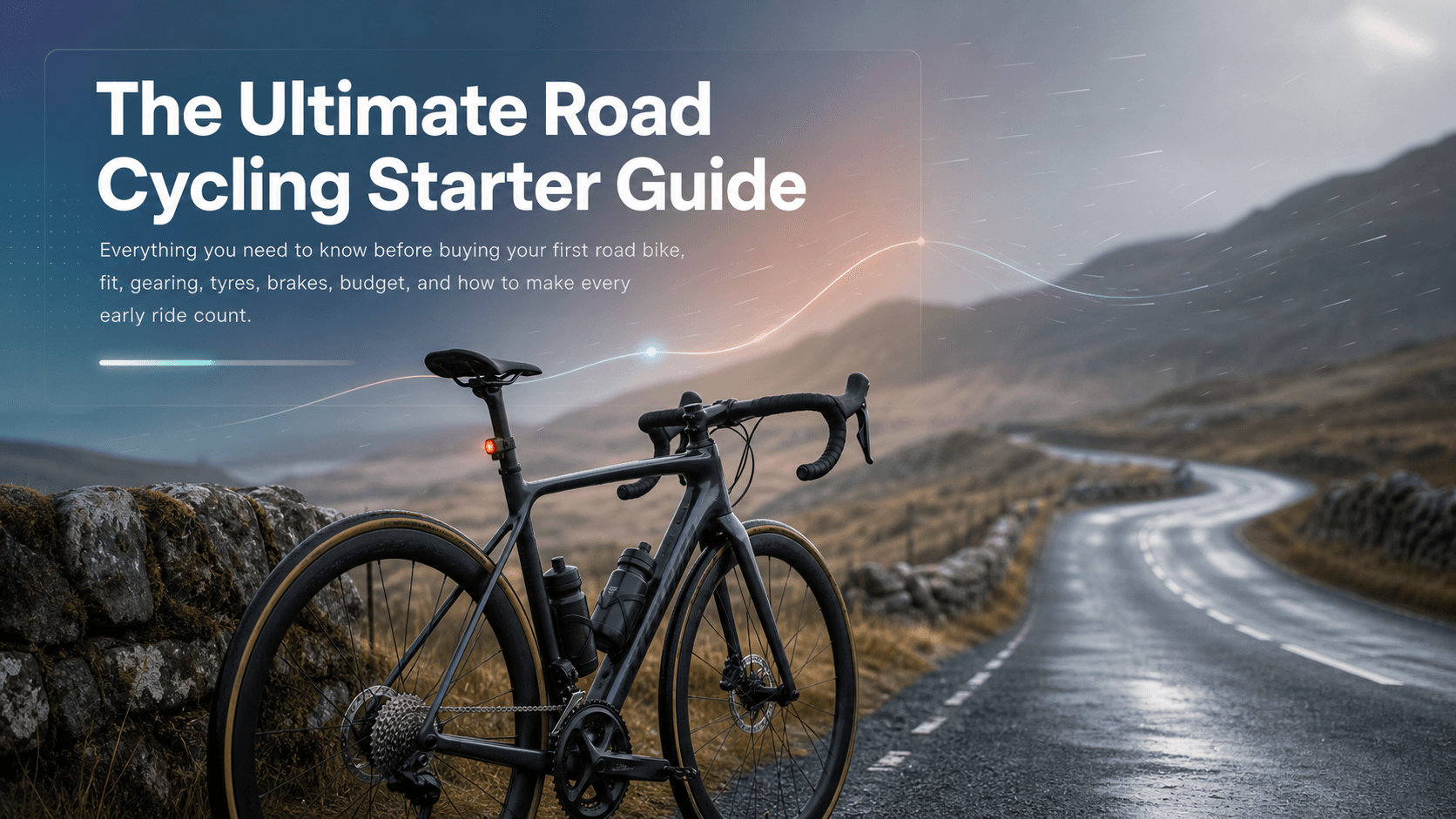
The Ultimate Road Cycling Starter Guide
Everything you need to know before buying your first road bike, fit, gearing, tyres, brakes, budget, and how to make every early ride count.
Buying your first road bike should be exciting. And it will be, once you understand that the bike itself is only half the decision. The other half is knowing how you'll actually ride it: which roads, which distances, whether you'll join a club run on Saturday mornings or just commute and potter. Get those questions answered first, and the specs almost choose themselves. Get them wrong, and you'll spend your first season fighting a bike that doesn't fit, grinding up hills in the wrong gear, or wondering why your hands go numb after 20 minutes.
This guide covers everything you need to know before you buy, from road bike sizing to groupsets, tyres to brakes, total cost to second-hand risks. Work through it in order, or jump straight to the section that's blocking your decision.
The five things that matter before anything else
If you only remember one idea from this guide, make it this: don't choose specs in isolation. A carbon frame means nothing if the geometry puts you in a position that hurts after an hour. A top-tier groupset won't fix gearing that's wrong for your local hills.
Here's the decision snapshot every first-time buyer needs:
- Fit first. The frame size is just a starting point. Stack, reach, and saddle height matter more.
- Category second. Endurance geometry or race geometry? This shapes everything else.
- Tyres and clearance. Especially on UK roads, this is not a detail to skip.
- Gearing for your actual terrain. Not for the flat roads you wish you had.
- Brakes for your actual weather. In the UK, that means wet descents are a real consideration.
Everything that follows unpacks each of these five areas.
1) Getting the size right (it's more than a number)
Frame sizes are labelled in centimetres or as S/M/L, but those labels don't tell you much on their own. Two bikes both marked 54cm can fit completely differently depending on their geometry.
Start with your height and inside-leg measurement to land on a ballpark frame size. Most manufacturers publish a sizing chart that maps these to a recommended frame size. That's your starting point, not your final answer.
The two numbers that actually determine how a bike fits you are stack (the vertical distance from the bottom bracket to the top of the head tube) and reach (the horizontal distance from the bottom bracket to the head tube). A higher stack gives you a more upright position; a longer reach stretches you out towards the bars. Endurance bikes tend to have higher stacks and shorter reaches than race bikes. If you're in doubt, that usually means endurance geometry fits more people more comfortably on day one.
When you visit a shop, ask three things:
- Can I test-ride this before committing?
- Can you set the saddle height and bar position to my measurements before the test?
- Do you offer a basic fit check, even a quick one?
Any decent independent bike shop will say yes to all three. If they won't let you test-ride, walk out.
Fit red flags to watch for during a test ride:
- Numb or tingling hands after 10 minutes, reach is likely too long or bars too low
- Hips rocking side to side, saddle is too high
- Knee pain on the inside or outside of the joint, saddle height or cleat position needs adjustment
- Feeling like you're perched on the nose of the saddle, the reach is too long and you're sliding forward to compensate
If any of these appear on a 10-minute test ride, they'll be significantly worse after two hours on a club run.
2) Endurance vs race geometry: pick the one that suits your life
At its simplest, an endurance road bike puts you in a more upright, comfortable position. A race bike puts you low and forward, which is more aerodynamic but asks more of your flexibility and core strength.
For most first-time buyers in the UK, especially those planning club runs, sportives, or weekend rides of 60-100km, an endurance bike is the better choice. You'll arrive at the café stop without a stiff neck. You'll still be able to sprint for the sign. And you'll have far more fun in the first six months while your fitness and flexibility catch up.
A race bike isn't wrong. But if you're honest about your current flexibility, how much time you have to train during the week, and whether you're chasing lap times or enjoying the miles, most beginners answer that question with "endurance."
Ask yourself: do you want to arrive fresh, or are you specifically chasing an aggressive aero position? If the answer is anything other than a clear "aero position," go endurance.
3) Tyres and clearance: the UK roads factor most people miss
Road bike tyres have been getting wider, and for good reason. According to BikeRadar, the sweet spot for many UK roads is 28mm, wide enough to absorb road buzz and drain water more effectively than a 23mm tyre, but still fast enough for road riding. Some newer endurance bikes comfortably clear 32mm or even 35mm.
Why does clearance matter at your buying stage? Because it determines your future options. A frame with only 25mm clearance locks you into narrow tyres forever. A frame that clears 30-32mm gives you the choice to run a bit wider for a wet autumn ride, or a bit narrower when you want pure speed. That flexibility is worth having, especially if you're not yet sure exactly what kind of riding you'll settle into.
When you're comparing bikes, check the manufacturer's stated maximum tyre clearance. If it's listed as 25mm or less, push back and ask why you'd limit yourself unnecessarily.
4) Gearing: choose for your hills, not your best-case flat roads
This is the area where beginners most consistently get it wrong, usually because they see a big chainring and assume it signals a fast bike.
For a first road bike, you want compact gearing: a 50/34 chainset paired with a cassette in the 11-32 or 11-34 range. That combination gives you genuinely useful climbing gears without sacrificing meaningful top-end speed. You'll rarely use the top three or four gears on a typical UK ride anyway.
The alternative, a standard 53/39 chainset with an 11-28 cassette, was designed for riders who are already fit and racing flat courses. On a lumpy sportive or a club run that includes any serious climbing, you'll be grinding and blowing up your legs in the first season.
Mechanically, lower gears reduce the torque you put through your knees and hips on every pedal stroke. For a new rider building fitness, that matters enormously. It's the difference between feeling strong at the end of a ride and limping home.
If you're planning to ride anywhere with hills in the UK (which, frankly, is most of the UK), compact gearing with a wide-range cassette is non-negotiable for your first bike.
5) Groupsets: what level is actually good enough?
Shimano's road groupset ladder runs roughly: Claris (8-speed) → Sora (9-speed) → Tiagra (10-speed) → 105 (11 or 12-speed) → Ultegra → Dura-Ace. SRAM and Campagnolo have their own equivalent ranges.
For a first bike under £1,000, you'll typically find Claris or Sora. Both are reliable and will work well for years with basic maintenance. The shifts are slightly less crisp than higher-end groups, but you'd need to ride them side-by-side with 105 to feel the difference.
For bikes in the £1,000-£1,500 range, Shimano 105 starts to appear. It's a meaningful step up in shift quality, weight, and long-term wear characteristics. If your budget stretches to it, 105 is a very satisfying group to live with.
As for Shimano 105 vs Ultegra at the first-bike stage: don't chase Ultegra. The difference in daily feel is small; the price difference is significant. Spend that money on a better saddle, a proper fit session, or a set of quality tyres.
Mechanical vs electronic shifting is a similar call. Electronic groupsets (like Shimano Di2) shift precisely and require no cable tension adjustment. But they're expensive, need occasional charging, and add complexity that isn't necessary when you're learning the basics of bike ownership. Stick with mechanical for your first bike.
6) Disc brakes vs rim brakes: the honest trade-off
This debate is largely settled for new bikes in 2026. The majority of new road bikes at every price point now come with disc brakes, and for good reason.
Hydraulic disc brakes offer consistent, confident stopping power regardless of weather. On a wet descent in the UK, which is a when, not an if, the difference in braking confidence between discs and rim brakes is noticeable. Hydraulic discs also require less hand effort to modulate, which reduces fatigue on long descents.
The trade-off is maintenance. Rim brakes are simpler: worn pads are cheap and easy to swap, cable tension is something you can adjust at the roadside, and there's nothing to bleed. Hydraulic disc brakes need the fluid bled periodically (typically once a year or if the lever feels spongy), and that's either a shop job (around £20-30) or a skill you learn at home. Rotors and pads cost slightly more than rim brake equivalents.
The honest decision guide:
- Ride in wet conditions regularly, or want predictable braking on descents? Go discs.
- Prioritise the lowest possible maintenance cost and simplest DIY work? Rim brakes are still a valid choice on entry-level bikes, though they're becoming harder to find.
- Buying a bike with hydraulic discs? Ask the shop to show you the lever feel and confirm the rotors aren't worn or warped.
One compatibility note: disc brake frames require disc-specific wheels (with a rotor mount). You can't retrofit discs to a rim-brake frame, so make sure you know which you're buying before you start comparing wheel upgrade prices.
7) Total cost: budget for the whole picture
The bike is the biggest line item, but it's not the only one. Here's what you'll need to be ride-ready from day one:
| Item | Approximate cost |
|---|---|
| Helmet | £40-£150 |
| Lights (front + rear) | £30-£80 |
| Lock | £20-£60 |
| Floor pump | £25-£50 |
| Saddle bag + inner tubes + tyre levers | £20-£35 |
| Cycling shorts (padded) | £30-£80 |
| Cycling jersey | £30-£70 |
| Pedals (if not included) | £15-£60 |
| Clipless shoes (if going clipless) | £60-£150 |
Realistic accessories total: £270-£735 on top of the bike price. Budget accordingly. A £900 bike bought with no budget left for essentials leaves you riding in jeans with no lights and no spare tube, which is neither safe nor enjoyable.
For a first bike, the sensible budget brackets are:
- Under £1,000: Expect Claris or Sora groupsets, aluminium frame, and basic finishing kit. Very capable bikes exist here, don't let the price put you off.
- £1,000-£1,500: Tiagra or 105 groupsets start to appear, often with better wheels and a more comfortable finishing kit. This is the sweet spot for many first-time buyers.
- £1,500+: You're getting into carbon frame territory, 105 as standard, and higher-quality components throughout.
If your budget is tight, buy at the lower end and invest in a single proper fit session (typically £80-£150 at an independent fitter). A well-fitted £800 bike will make you faster and more comfortable than a poorly fitted £1,500 one.
8) What to check on a test ride
Don't leave the shop without riding the bike, even if it's only around the car park. Here's what to check:
- Seat height: your leg should have a very slight bend at the bottom of the pedal stroke, not fully extended and not cramped
- Knee tracking: your knee should travel straight up and down over the pedal, not drifting inward or outward
- Hand comfort: you shouldn't feel like you're stretching to reach the hoods, and your weight should feel balanced
- Shifting: run through all the gears in both directions, shifts should be positive and quiet
- Braking: squeeze both levers under a little load to check for feel and confidence
Also ask the shop: what's the warranty on the frame and components? Will you set the bike up fresh for me when I collect it? Do you offer a free first service? Most reputable shops will say yes to all of these.
9) New or second-hand? How to decide
A second-hand road bike can save you several hundred pounds, but the risks are real if you don't know what to look for.
The case for buying new: You know the service history (zero), the components are set up correctly, and you have warranty cover. For a first-time buyer who can't easily spot worn chain rings or a cracked frame, new is the safer choice if the budget allows.
The case for buying second-hand: A quality used bike at a reasonable price can give you a better specification than a new bike at the same price. This can make sense if you can inspect it properly or take a knowledgeable friend.
Second-hand inspection checklist:
- Check the frame for cracks, especially around the head tube, bottom bracket shell, and top tube/seat tube junction
- Squeeze the front and rear wheels between your hands to check for side-to-side play in the bearings
- Spin the wheels and look for wobble (lateral or vertical) indicating they need truing
- Check the chain with a chain wear indicator tool (or ask the seller when it was last replaced)
- On disc brake bikes, check rotor thickness and look for scoring on the rotor surface
- Test shift through all gears and listen for grinding or hesitation
- Ask for the original purchase receipt if possible
Buying from a local independent shop that takes trade-ins gives you more confidence than a private marketplace sale. Shops that service bikes before resale are worth the small premium.
Frequently asked questions
What size road bike do I need? Start with your height and inside-leg measurement against the manufacturer's sizing chart to get a frame size range. Then refine with stack and reach numbers once you've ridden the bike. A professional fit session eliminates the guesswork entirely and is worth the cost if you're between two sizes.
Are 28mm tyres wide enough, or should I go wider? 28mm is a solid choice for most UK roads and a commonly recommended sweet spot according to BikeRadar. If your frame clears 30mm or 32mm, running a slightly wider tyre on rough roads or in winter is a genuine comfort upgrade. Buy a bike with clearance for at least 28mm, ideally 30-32mm.
Disc brakes or rim brakes for UK weather? For the UK, disc brakes are the more practical choice. Wet roads and descents with unpredictable grip are a regular reality, and hydraulic discs give you consistent, predictable stopping power in those conditions. Rim brakes work, but they require more hand effort in the wet and the performance drop is noticeable.
Is Shimano 105 worth it for a first bike? Yes, if your budget stretches to it. 105 shifts crisply, lasts well, and is repairable and upgradeable. But Tiagra and Sora are genuinely reliable, don't stretch your budget so far on the groupset that you can't afford accessories or a fit session.
Can I ride a road bike on slightly rough roads? Yes, especially with 28mm+ tyres and some tyre pressure flexibility. For very rough surfaces, gravel tracks, or mixed-surface riding, a gravel bike (with wider tyre clearance and a more relaxed geometry) would serve you better. But a modern endurance road bike with good tyres handles typical UK patchy tarmac comfortably.
Should I buy clipless pedals straight away? Not necessarily. Flat pedals are completely fine while you're getting used to the bike, building fitness, and learning to ride with traffic. Add clipless pedals (and compatible shoes) once you're comfortable on the bike and ready for the small learning curve that comes with clipping in and out. Many beginners fall over exactly once at a junction while learning, and that's perfectly normal.
Your first rides matter more than you think: plan them well
Once you've chosen the right bike, the next thing most new road cyclists underestimate is how much the conditions on your early rides shape how you feel about the sport. A first club run into a 30kph headwind on a cold, damp morning will feel like punishment. The same ride with a tailwind and dry roads is exhilarating.
You can't control the weather, but you can choose when to ride based on it. Tailwind GPS was built specifically for this. It analyses wind direction and speed along every kilometre of your actual route (not just a pin on a map), and gives each departure hour a Tailwind Score from 0 to 100. An 80+ score means favourable conditions for most of the ride. A score below 30 means you're going to earn it the hard way.
For your first few months of riding, that information is genuinely useful. If Saturday morning looks like a 72 and Sunday morning looks like a 45, you know which day to set the alarm. Free accounts include up to 3 saved routes and 3-day forecasts, more than enough to start planning your regular loops. Subscribers unlock 14-day planning windows and route-specific alerts for club rides, so you can monitor conditions across the week before committing to a start time.
You've put serious thought into buying the right bike. It makes sense to put the same thought into riding it at the right time.
Connect your Strava account and your routes appear automatically. Check the wind scores for your routes before your next ride and see the difference it makes to how you plan your week.
Try the map
See hourly Tailwind Scores on your routes before your next ride — no sign-up required.
Related posts
Common Cycling Mistakes Beginners Make
Avoid the 12 most common beginner cycling mistakes, from saddle height and gear choice to route planning and wind timing. Fix them fast with our guide.
·7 min read
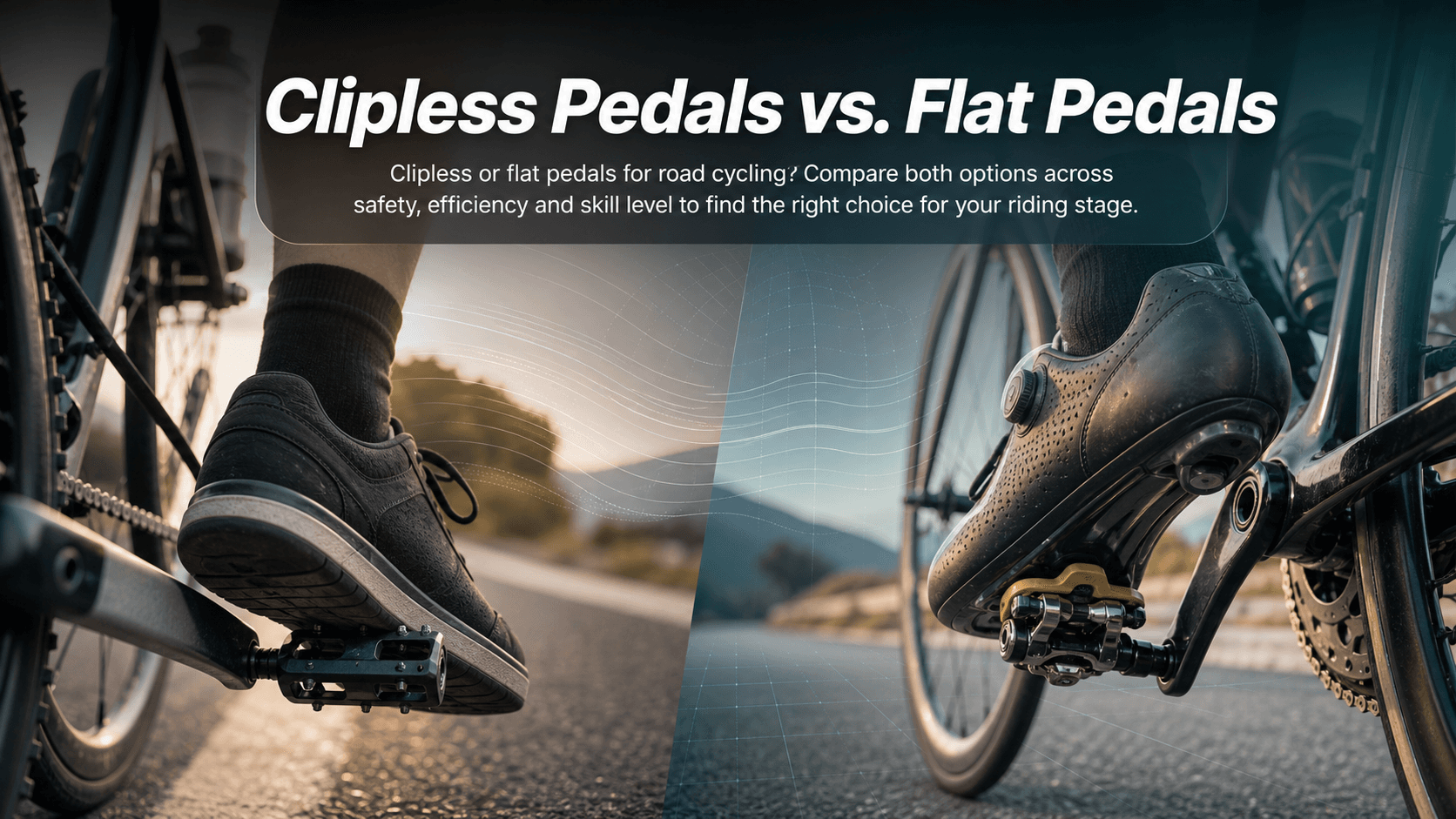
Clipless Pedals vs. Flat Pedals
Clipless or flat pedals for road cycling? Compare both options across safety, efficiency and skill level to find the right choice for your riding stage.
·8 min read
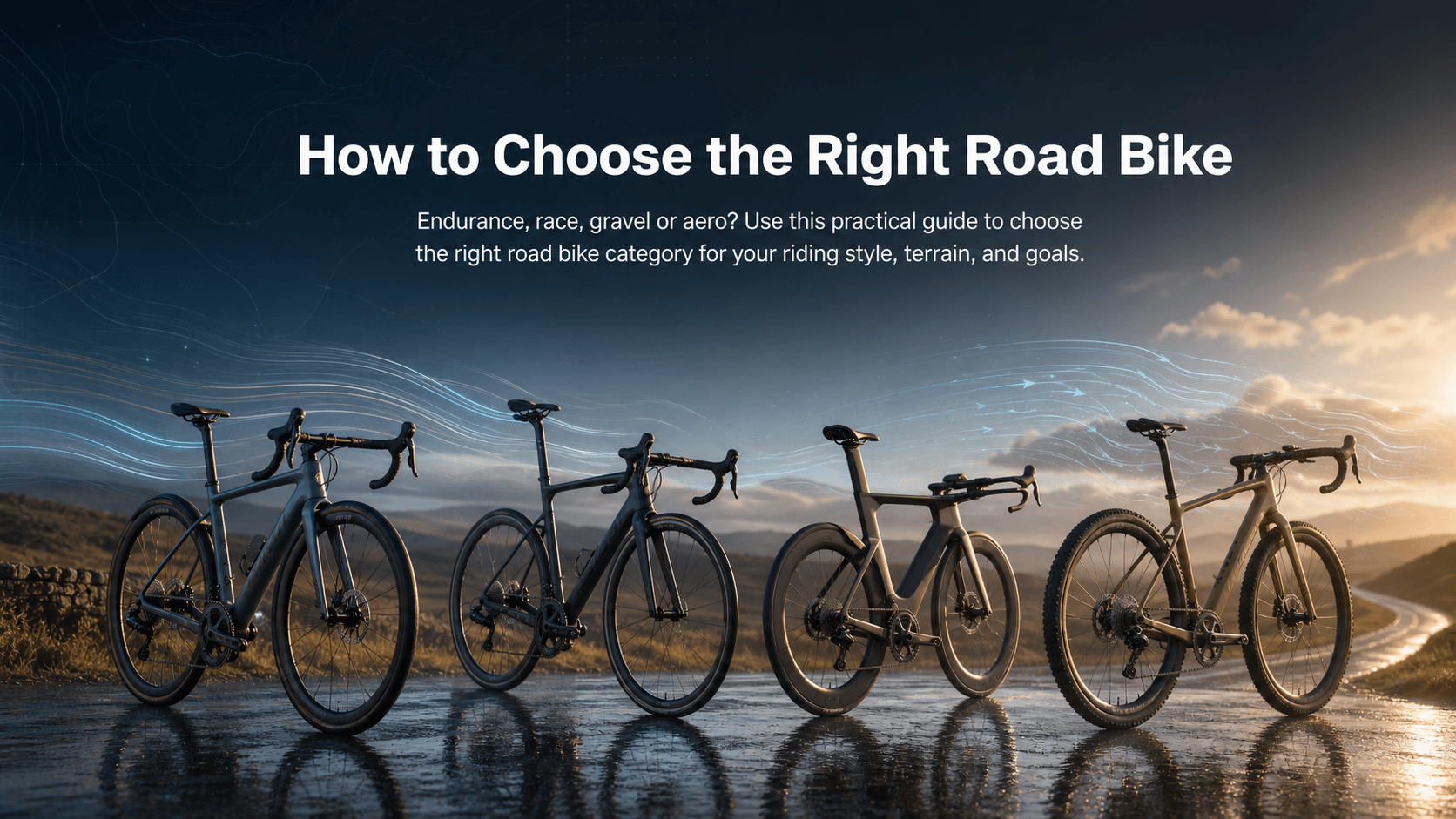
How to Choose the Right Road Bike
Endurance, race, gravel or aero? Use this practical guide to choose the right road bike category for your riding style, terrain, and goals.
·11 min read