Tailwind GPS vs Bikemap for cycling route planning (2026)
Compare Tailwind GPS and Bikemap for cycling route planning. See which app wins on wind scoring, offline maps, GPX export, departure-time forecasts, and more.

You've checked the weather app. It says "15 km/h, south-westerly." Fine. You head out, turn left onto the exposed section of your usual loop, and spend the next 45 minutes grinding into a direct headwind that the forecast never mentioned.
That's the gap both Tailwind GPS and Bikemap are trying to fill, in different ways. One is built around route discovery and navigation. The other is built around answering a single question: given your actual route, when should you leave?
Here's how they compare.
Quick verdict: which one should you use?
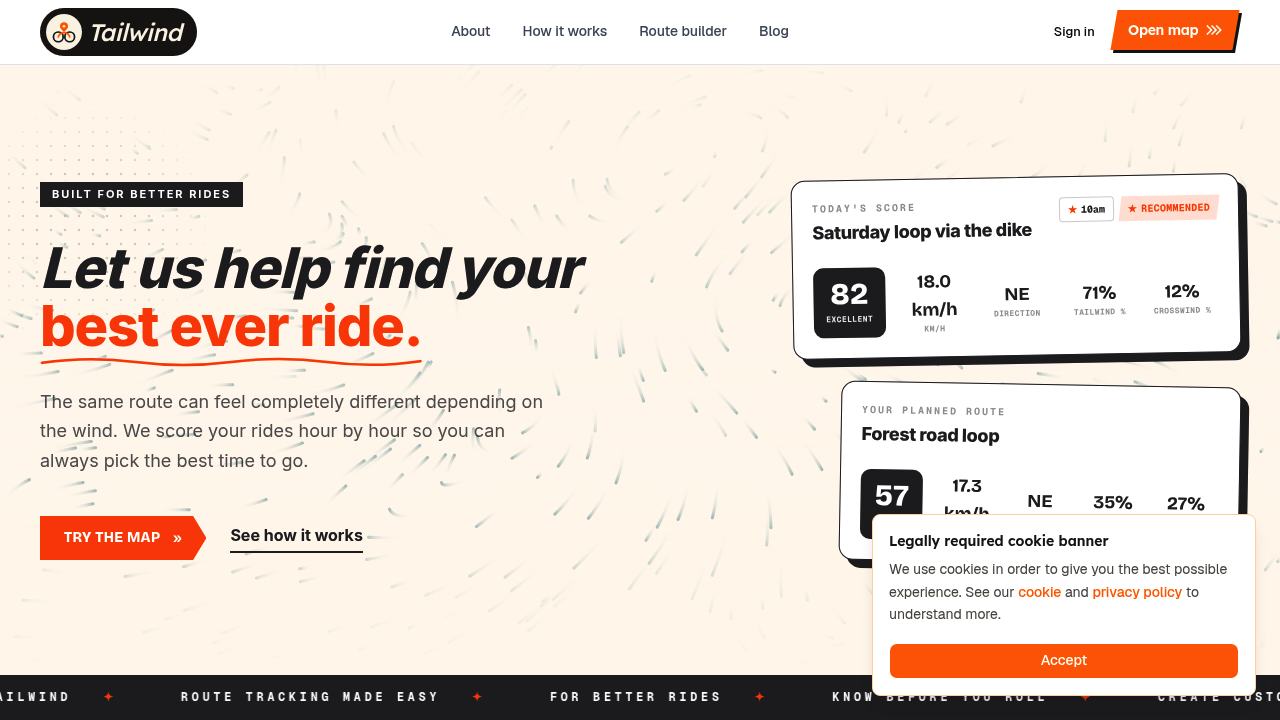
Pick Tailwind GPS if you want to:
- Know your best departure time based on wind conditions on your specific route
- Get a single, easy-to-read Tailwind Score (0–100) for every hour of the day
- Avoid headwinds, choose the calmest or fastest window, or deliberately seek out tough sessions with Headwind Training mode
- Receive route-specific alerts when your favourite loops hit a target score
- Plan up to 14 days ahead with a paid subscription
Pick Bikemap if you want to:
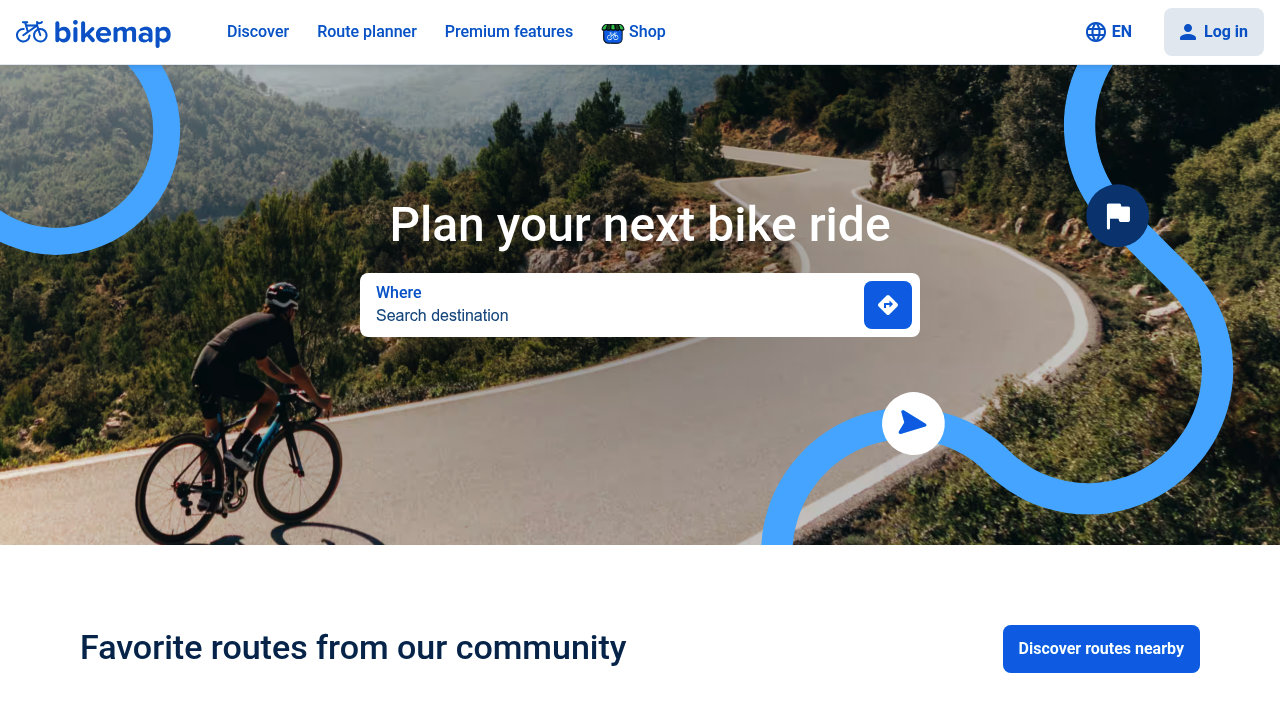
- Discover new routes from a large community-built library
- Navigate turn-by-turn with offline map support (Premium)
- Browse routes by location, distance, and elevation
- Use a full-featured route editor with elevation profiles and detailed stats
- Access weather along your route as part of a Premium subscription
What they both do well
Before getting into the differences, it's worth being clear about where the two tools actually overlap.
Both let you create routes on an interactive map and save them for later. Both support GPX files, so you can move routes onto a Garmin, Wahoo, or any other head unit. Both have Strava integration, which matters for cyclists who already have their regular loops saved there. Tailwind GPS pulls your Strava routes in automatically when you connect your account; Bikemap also lists Strava integration in its product features.
Bikemap's route planner includes detailed statistics and an elevation profile alongside the map view, making it easy to assess the shape of a ride before you go. Tailwind GPS focuses on wind scoring rather than elevation-first analysis, but still gives you a full map view and route creation tools.
So if you just want to draw a route, save it, export a GPX, and ride, either platform will do the job. The meaningful split comes when you ask: what do I do once the route is saved?
The real difference: wind and departure-time intelligence
This is where Tailwind GPS separates itself from almost every other cycling app, including Bikemap.
Tailwind GPS scores your rides hour by hour. Every saved route gets a Tailwind Score (0–100) for each departure hour, calculated by sampling wind speed and direction along every segment of the route, weighted by distance and personalised to your riding pace. The scoring bands are:
- 80–100: Excellent. Favourable tailwinds for most of the ride.
- 55–79: Great riding conditions.
- 40–54: Neutral.
- 20–39: Challenging.
- 0–19: Prepare for a tough ride.
The key word is hourly. Say you're planning a 50 km loop and it's blowing a south-westerly. At 10:00am the route scores 28 (Challenging). By 17:00pm the wind has eased and the score flips to 72 (Great). Tailwind GPS shows you that shift at a glance. You rearrange your afternoon, leave later, and it's a completely different ride.
Bikemap does offer weather along your route as a Premium feature. According to its App Store listing, Premium subscribers can "check the detailed weather by route and time, with wind graphs and 10-day outlooks." That's genuinely useful, and it's more than most route apps provide. But Bikemap doesn't present this information as a single decision score, and it's not designed around departure-time optimisation the way Tailwind GPS is. You're reading wind graphs rather than being told: leave at 17:00, score is 72.
For cyclists who want to avoid headwinds on a bike route without becoming amateur meteorologists, that distinction matters.
Forecast horizon and planning window
Tailwind GPS gives free users a 3-day wind forecast covering all their saved routes. Paid subscribers (from $2.99/month or $19.99/year) unlock a full 14-day planning window, which is long enough to plan a sportive, a holiday ride, or a week of training sessions with genuine confidence.
Bikemap's route weather feature, available to Premium subscribers, provides a 10-day outlook according to its public App Store description. That's a solid window for most weekend planners.
The 14-day horizon matters most if you ride for specific events or block out time far in advance. Being able to look at conditions two Saturdays from now and say "yes, that's the one" changes how you schedule rides around work and family commitments.
Pricing and what you actually get
| Tailwind GPS Free | Tailwind GPS Paid | Bikemap Premium | |
|---|---|---|---|
| Routes | Up to 3 tracked routes | Up to 40 tracked routes | Not specified (verify on publish) |
| Forecast window | 3-day wind forecast | 14-day wind forecast | 10-day weather outlook (Premium) |
| Wind scoring | Yes, hourly Tailwind Score | Yes, hourly Tailwind Score | Wind graphs (no single decision score) |
| Offline maps | No | No | Yes, worldwide |
| Turn-by-turn navigation | Yes (browser, online) | Yes (browser, online) | Yes (Premium) |
| GPX import/export | Yes | Yes | Yes |
| Strava sync | Yes | Yes | Yes |
| Route alerts and notifications | No | Yes (email alerts, wind score notifications, rain alerts) | Not confirmed |
| Headwind Training mode | No | Yes | No |
| Price | Free | $2.99/month or $19.99/year | Approx. €9/month, €39/year, €99 for 3 years (verify current prices) |
Two things to call out here. First, the free tiers serve genuinely different use cases: Tailwind GPS's free plan is a wind-scoring tool with three routes, while Bikemap free is primarily a route discovery browser. Second, the paid tiers aren't really competing for the same job: Tailwind GPS's subscription buys you more wind intelligence; Bikemap's subscription buys you offline navigation capability.
You can also see Tailwind GPS's pricing and free plan details explained in full if you want to dig into what the free tier actually covers before committing.
Route creation and sharing: which is faster for cyclists?
Tailwind GPS lets you draw routes directly on the map with waypoint snapping, import GPX files, and share routes via a simple link. According to the Tailwind GPS homepage: "Want to propose a route to the club? You can instantly create a shareable link… They can then download the GPX file directly." For club ride route planning, that workflow is fast and practical, especially when you want to share a route alongside a wind score so everyone knows the best window.
Bikemap's route editor is strong, with detailed elevation profiles and statistics. The bigger advantage Bikemap has is community. Its homepage positions it around a large collection of user-generated routes, so if you're riding somewhere new and don't want to build a route from scratch, Bikemap's browse-and-filter library is genuinely useful.
For your home loops and regular rides, Tailwind GPS is faster because it connects the route directly to a forecast. For discovering new territory, Bikemap's library has an edge.
Alerts and training: the ride decision layer
One of the most practical things Tailwind GPS does is watch the forecast for you. Paid subscribers receive:
- A weekly email with the best ride windows across all their saved routes
- Route-specific email alerts when a favourite route hits a chosen Tailwind Score threshold
- Wind score notifications as forecasts change
- Rain alerts during your preferred riding window
Set your preferences once and Tailwind GPS monitors conditions in the background. When your Saturday loop hits a score of 80 or above, you get an email. No daily forecast-checking required.
There's also Headwind Training mode, which flips the logic around. Instead of finding the easiest conditions, it surfaces routes and windows with sustained headwinds so you can train effectively in headwinds deliberately. That's a genuinely different training tool that doesn't exist in Bikemap's feature set.
Bikemap's strength is route planning and navigation. It doesn't offer the same proactive alert system or headwind training capability.
Offline maps and navigation (where Bikemap has a strong case)
If you're riding somewhere unfamiliar, exploring gravel routes without phone signal, or trying to avoid data roaming charges abroad, turn-by-turn navigation with offline maps is essential. That's where Bikemap's Premium tier earns its keep.
Bikemap Premium includes worldwide offline maps and navigation, according to its Premium page. Load the area before you leave on Wi-Fi, then follow turn-by-turn directions even with no signal. For touring cyclists, commuters navigating complex urban areas, or anyone riding off the back of a van in the Pyrenees, that's a hard thing to replicate with Tailwind GPS alone.
Tailwind GPS doesn't offer offline navigation. When you have a signal, you can follow any saved route with browser-based turn-by-turn guidance and voice prompts. You can also export a GPX to load onto your Garmin or Wahoo if you prefer a head unit. That combination — score the route, then navigate from the same app or your device — works well for riders who want one workflow from planning to pedalling.
GPX workflow: import, export, and your head unit
Both platforms support GPX import and export, which means both integrate with external GPS devices. Tailwind GPS states clearly that it supports "uploading and downloading all GPX files" and that routes can be downloaded directly to head units. The best cycling route planner for GPX workflows are covered in detail elsewhere, but the short version: draw or import in Tailwind GPS, score the route, export the GPX, and push it to your Garmin or Wahoo.
Bikemap's route planner also supports GPX export for use on GPS devices, consistent with its positioning as a full route planning and navigation platform.
For Garmin and Wahoo users, the practical workflow is similar in both cases: plan on your phone, transfer the file, navigate on the device. The difference is that Tailwind GPS adds a departure-time recommendation before you leave.
Recommendation by rider type
A familiar loop with flexible timing. If your route is set and you can shift your departure time by 30–60 minutes, Tailwind GPS is the more useful daily tool. It tells you whether leaving at 7:30am or 8:15am puts the wind at your back. If you mainly need turn-by-turn navigation through unfamiliar streets, Bikemap Premium covers that better.
The club rider organising a Sunday loop. Tailwind GPS lets you share a route link with wind scores, set a rain alert for the group's start time, and recommend the best departure window. Bikemap is a better fit if your priority is sharing a navigable route that members can follow on their phones with offline support.
The gravel explorer heading somewhere new. Bikemap's community route library is a genuine advantage for discovering local routes before a trip. Once you've found one, import the GPX into Tailwind GPS to score it for wind before you go, especially if the route has long exposed sections where a crosswind or headwind would hit hard.
The cyclist training with purpose. If you want to find your best-ever ride conditions, Tailwind GPS's hourly scoring and route alerts are the tools for that. If you're deliberately seeking harder sessions, Headwind Training mode surfaces exactly those windows. Bikemap doesn't have a comparable feature.
For most cyclists, these tools are more complementary than competitive. Bikemap helps you find and navigate routes; Tailwind GPS helps you decide when those routes will feel great. Used together, they cover the full picture. But if you can only use one for ride-day wind decisions, Tailwind GPS's wind-aware approach is the more direct answer to that specific problem.
Frequently asked questions
Is Bikemap better for route discovery or route planning? Both, really. Its community route library is excellent for discovery, and the route editor handles planning well. Navigation (Premium) adds turn-by-turn guidance on top.
Does Bikemap show wind along your route? Yes, as a Premium feature. According to Bikemap's App Store listing, Premium subscribers get "detailed weather by route and time, with wind graphs and 10-day outlooks."
Does Tailwind GPS give a score and tell you when to leave? Yes. Every saved route gets an hourly Tailwind Score (0–100) across the forecast window. You compare departure times, pick the highest score that fits your schedule, and go. Free users see 3 days ahead; subscribers see up to 14 days.
How many routes can I save for free? Tailwind GPS offers up to 3 tracked routes on the free plan, permanently. Bikemap's free route saving limits aren't clearly documented in publicly available snippets; check Bikemap's pricing page before committing.
Can I export GPX to my GPS device from both? Yes. Tailwind GPS supports uploading and downloading all GPX files, and Bikemap's route planner also includes GPX export for GPS device use.
What's the Tailwind Score, exactly? It's a 0–100 rating calculated by sampling wind direction and speed along every segment of your route, hour by hour, personalised to your riding pace. An 80+ score means excellent conditions; below 20 means a tough ride. The idea is that you get one clear number per departure hour rather than a dashboard of data to interpret yourself.
Are these two apps direct competitors? Only partially. Their strongest features don't overlap. Tailwind GPS is a wind-aware route scoring tool designed around departure-time decisions. Bikemap is a route planner and navigation app with community features. Many cyclists use both.
Try it now
Score your saved routes by departure hour and see which loop rides best this weekend.
Related posts

Introducing Ride Huddles: a simple way to choose your next group ride
Ride Huddle is a simple way for groups to choose a route together. Create a Huddle, add your routes, share one link, and let everyone vote — free, with no account required.
·2 min read

How to navigate a cycling route without getting lost
Stay on the line with in-browser turn-by-turn: voice prompts, navigate-to-start, and rerouting. Tailwind GPS is the phone navigation — export GPX only for a head unit.
·8 min read
How to plan a cycling route and navigate it on your phone
Plan a cycling route on your phone, pick the best hour, then start in-browser turn-by-turn. Tailwind GPS includes voice prompts, navigate-to-start, and rerouting.
·6 min read